
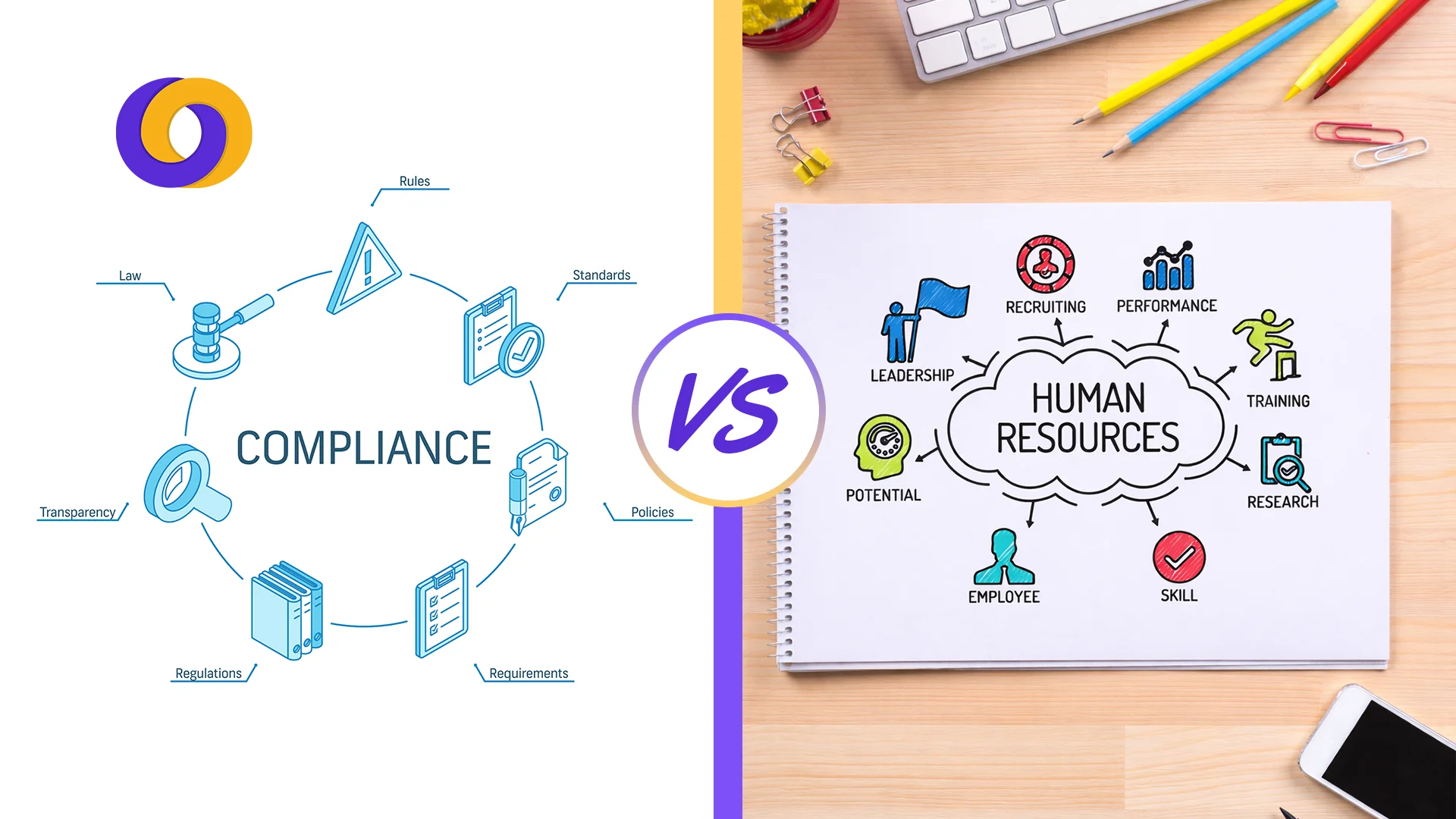
Often finding their domains overlapping in any expanding company are two very important processes: compliance and human resources (HR). Who should address an employee complaint, a fresh law on data protection, or a concern on maternity leave? The solution is not always obvious, and misunderstandings can cause serious legal and cultural hazards, duplicated effort, or worse, important gaps.
Although both are committed to safeguarding the organisation and its people, their objectives, attitudes, and approaches are very different. Consider HR as the designer and steward of the employee experience, concentrating on performance, people, and culture. Conversely, compliance is the auditor and custodian of ethical and legal borders; it stresses laws, risk, and standards.
This guide will precisely define every function, map their several duties, and show where they must work together smoothly. The first stage in developing a resilient, moral, and successful business is knowing who takes care of what.
Defining the Core Functions
Let’s start with understanding both the terms:
What is Human Resources (HR)?
Managing the employee life cycle and maximising workforce potential is the purview of the strategic business operation of human resources. Its main objective is to draw, grow, inspire, and retain talent to meet company objectives. HR policy is essentially people-centric and proactive; therefore, it concentrates on:
- Talent Management: Recruitment, onboarding, training, and development.
- Employee Relations: Conflict resolution, performance management, and creating a good environment all contribute to this.
- Total Rewards: Developing competitive incentives, advantages, and recognition plans.
- Organisational development: Moulding culture, promoting involvement, and enabling change.
Employee happiness, retention rates, time-to-hire, and general productivity are all measures of HR’s success.
What is Compliance?
The department responsible for making sure the company abides by all outside laws, rules, and internal policies is compliance. Its main goal is to reduce reputational, financial, and legal risk. Essentially reactive (to legislation), compliance is also preventative, concentrating on:
- Legal Adherence: Implementing procedures to abide by employment law, health and safety regulations, data protection (GDPR), and industry-specific codes qualifies as legal compliance.
- Risk Management: Finding, evaluating, and managing hazards associated with employee activity.
- Auditing and Monitoring: Checks to guarantee appropriate policy adherence.
- Reporting & Investigation: Handling whistleblower channels and looking into possible infractions constitutes reporting and investigation.
The absence of incidents—no legal claims, no regulatory penalties, and no ethical scandals—defines the success of compliance.
What is the Difference Between HR and HR Compliance?
The process begins at this location, which establishes the operational difference between the two elements. HR functions as an expanded version of the general HR function, which exists beyond its current boundaries. The HR function includes HR compliance as its essential component, which operates either within or outside HR activities.
HR develops organizational policies through its work, which includes creating a parental leave policy that attracts potential employees.
HR Compliance verifies that the policy meets legal requirements which include the Employment Rights Act and the Equality Act minimum standards, and ensures proper implementation of the policy.
In simpler terms:
HR asks, “How can we best support our employees and help the business grow?”” to find appropriate solutions.
HR Compliance asks, “Are we breaking any laws? How do we prove we’re following them to establish legal compliance procedures?
One aspect of the organization develops its culture and organizational growth, while the second aspect provides protection against business threats that might disrupt operations. The two elements exist as a single entity that displays two different characteristics: one shows compassion and creates plans, while the other demonstrates dedication to thoroughness and assessment.
The Responsibility Map: Who Handles What?
To eliminate confusion, here’s a clear breakdown of typical responsibilities:
Scenario / Task | Primary Owner | Reason & Collaboration |
Drafting a new hybrid work policy | HR | HR designs the policy for culture, attraction, and productivity. They must then consult with Compliance to ensure it meets health & safety and data security regulations. |
Ensuring right-to-work checks are completed & documented | HR Compliance | This is a strict legal requirement. HR administers the process, but Compliance sets the auditable standard and verifies it’s fail-proof. |
Managing an employee’s grievance | HR | HR facilitates the process to resolve conflict and maintain relations. Compliance would only step in if the grievance alleges a major policy breach (like harassment or discrimination) that poses a legal risk. |
Conducting a GDPR audit on employee data storage | Compliance | This is a direct legal/regulatory audit. Compliance leads it, but HR must provide full access to employee records and processes. |
Running annual performance reviews | HR | This is a core talent management activity. Compliance may provide guidelines to ensure reviews are non-discriminatory and that records are kept fairly. |
Investigating a whistleblowing report about financial misconduct | Compliance | This is a core compliance activity to investigate potential breaches of law or ethics. HR would be involved if disciplinary action against an individual is required. |
Final Thoughts
Rather than a competition, HR and Compliance should form a strategic alliance. HR creates the car—the engaged, efficient staff that propels the firm ahead. Compliance guarantees the voyage is safe and legal by providing the guardrails, seatbelts, and regulatory MOT.
For this collaboration to be successful, communication is essential. HR must include compliance early in strategic meetings. Compliance must enlighten HR on changing legal environments. Organizations have a strong benefit when silos collapse: a work environment that is both pleasurable to work for and safe to work in.
Understanding the confluence of rigorous compliance and HR practices can be difficult. Giving you assurance and clarity, Smart Workforce offers integrated tools assisting HR teams in managing core procedures—like BS7858 staff vetting, and attendance tracking, etc.
Book a free demo today.
Frequently Asked Questions
What is the difference between HR Compliance, General HR, and Strategic HR?
General human resources manage daily operational duties like payroll, administration, and simple employee inquiries. The division of human resource compliance guarantees legal requirements are met for every activity and procedure.
Strategic HR concentrates on long-term objectives like talent development, culture shaping, and workforce alignment with corporate strategy. Minimising legal risks that could compromise long-term plans helps strategic HR through compliance.
What is the difference between a healthcare compliance officer and HR?
A healthcare compliance officer concentrates on clinical, patient safety, and data privacy rules unique to healthcare (e.g., CQC standards, NHS frameworks, and patient confidentiality).
HR in healthcare centres on the workforce itself: hiring of clinicians, management of their employment terms, and management of staff interactions. Particularly on topics such as clinical staff credentialing or incident management involving both staff behaviour and patient safety, they collaborate very closely.
Is a compliance officer the same as HR?
Nope. Though they collaborate, their parts differ. An employee advocate and business partner specializing in people strategy is an HR professional. Focused on the law, a compliance officer is a legal and risk-management expert. One employee in some SMEs may wear two hats; however, doing so calls for careful planning to prevent clashes between regulatory enforcement and employee advocacy.

0 Comments