
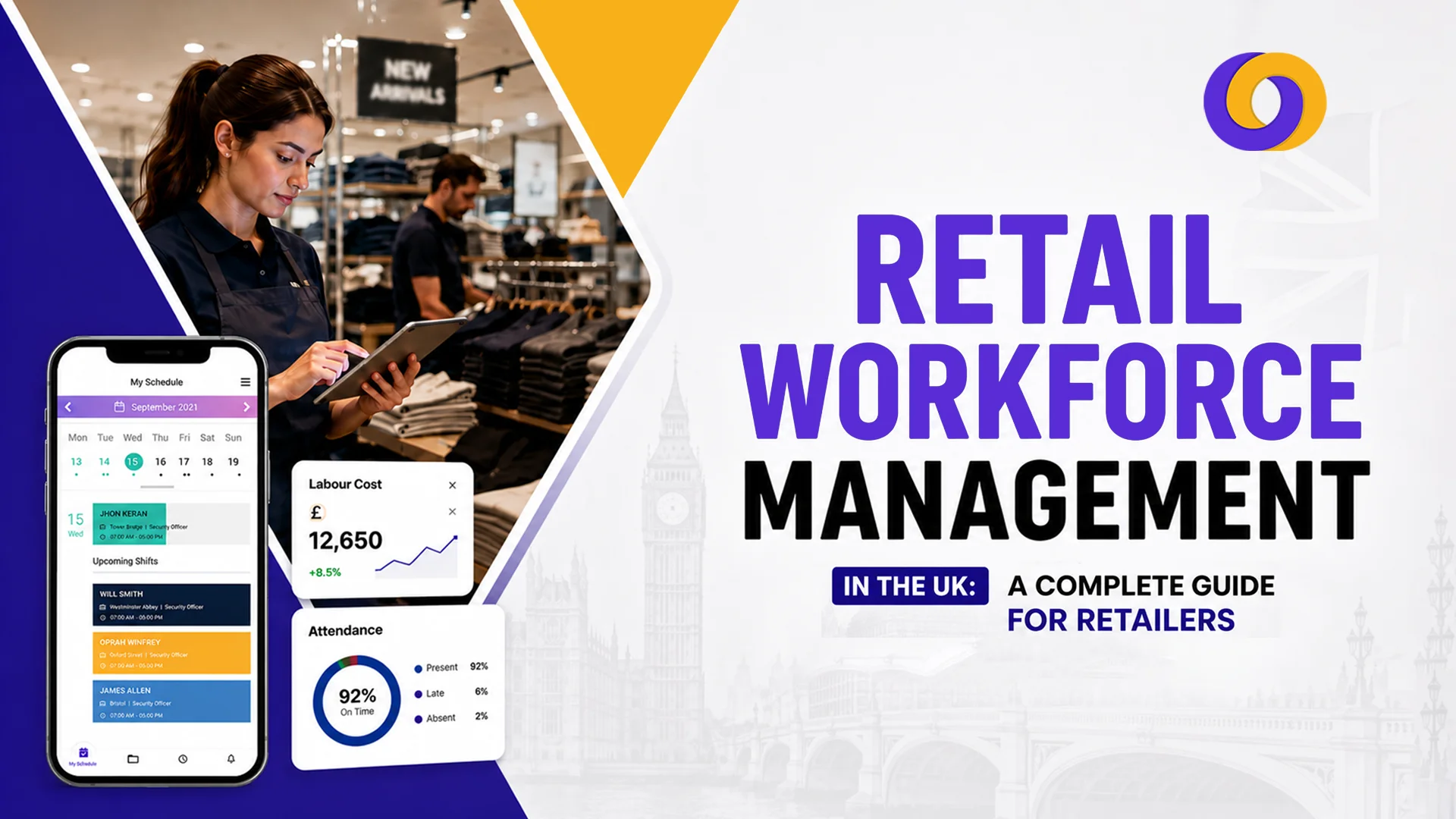
TL;DR
- Labour is your largest controllable expense. For UK retailers, payroll typically accounts for 30-35% of turnover, making efficient workforce management essential for profitability.
- Demand forecasting transforms scheduling. Using sales data, footfall, and local events to predict busy periods can reduce overstaffing and understaffing simultaneously, lowering labour costs by 5-15%.
- Compliance is non-negotiable. UK retailers must manage working time regulations, national minimum wage (currently £12.71 for 21+), and the Employment Rights Act 2025’s day-one sick pay and flexible working rights.
- Employee engagement drives retention. Better scheduling, predictable rotas, and shift-swapping tools reduce the turnover that costs UK retailers an estimated £3,000-£5,000 per leaver.
- Technology enables workforce optimisation. Modern retail staff management software integrates scheduling, time and attendance, payroll, and compliance in a single platform, freeing managers to focus on customers and sales.
The Saturday rush. Three tills open. A queue stretching to the back of the store. Two staff called in sick. One is on annual leave. The store manager is on the till, and the stockroom is piling up.
This scene plays out in UK merchandising stores every weekend.
The retail sector employs over 3 million people in the UK, making it one of the country’s largest employers. Yet it also faces some of the most complex workforce challenges: unpredictable customer demand, high staff turnover (often 30-40% annually), tight margins (typically 2-5% net profit), and ever-changing compliance requirements.
Workforce management for retail is the discipline of optimising your people to deliver excellent customer service at sustainable labour costs. It’s not just about scheduling shifts—it’s about forecasting demand, controlling costs, tracking attendance, managing absences, and keeping your team engaged.
This guide covers everything UK retailers need to know about retail workforce management in 2026, from strategies and compliance to software and best practices.
What Is Retail Workforce Management?
Vendor staff management is the strategic process of optimising staff scheduling, labour costs, and operational efficiency in retail environments. It encompasses everything from demand forecasting and rota creation to time tracking, payroll integration, and compliance monitoring.
At its core, retail staff management answers four critical questions:
- How many staff do we need? – Based on footfall, sales data, and customer demand
- When do we need them? – Matching staffing to peak trading hours
- Who should work which shifts? – Matching skills, availability, and preferences
- How do we control labour costs? – Balancing service levels with budget constraints
- How do we keep staff engaged and reduce turnover? – Retail turnover averages 30-40% annually, costing £3,000-5,000 per leaver.
Unlike generic scheduling tools, retail workforce management software is designed to handle the sector’s unique challenges: seasonal peaks, part-time and casual contracts, unpredictable footfall, and high turnover.
Why Retail Workforce Management Matters
With payroll consuming 30-35% of vending turnover, staff management directly determines whether a store is profitable or loss-making, and every hour of overstaffing eats margin while every hour of understaffing drives customers away.
Add high turnover, rising compliance burdens, and unpredictable customer demand, and retailers that fail to optimise their workforce are leaving money on the table—and giving competitors an edge.
The Cost of Getting It Wrong
Problem | Impact |
Overstaffing | Labour costs (typically 30-35% of retail turnover) skyrocket; profits evaporate |
Understaffing | Long queues, poor customer service, lost sales, bad reviews |
High turnover | Recruitment and training costs £3,000-5,000 per leaver; knowledge and service quality suffer |
Compliance failures | Employment tribunal claims, HSE fines, reputational damage |
Payroll errors | Overpayments, underpayments, staff resentment, HMRC penalties |
The Opportunity
Effective workforce optimisation delivers measurable returns:
- Labour cost savings of 5-15% – Worth £10,000-30,000 annually for a retailer with £200,000 payroll
- 20-30% reduction in agency spend – By filling gaps internally
- 15-25% lower staff turnover – Through fairer, more predictable rotas
- Improved customer satisfaction – Consistent service during peak hours
- Reduced manager admin time – Saving 5-10 hours weekly (worth £5,000-10,000 annually)
Example: A UK clothing retailer with 10 stores and £2m annual payroll implemented workforce management software. Within 12 months, labour costs dropped by 8% (£160,000), staff turnover fell by 20%, and customer satisfaction scores increased by 12%.
Core Components of Retail Workforce Management
Discussed here are the important elements of effectively managing retail staff:
1. Demand Forecasting
The foundation of good scheduling. You cannot build an efficient rota without knowing how busy you’ll be.
Data sources for demand forecasting:
- Point-of-sale (POS) data – Sales by hour, day, month, season
- Footfall counters – Customer traffic patterns
- Local events – Concerts, sports matches, festivals
- Weather forecasts – Impact on foot traffic (especially for outdoor shopping)
- Historical patterns – Same-day, same-week, same-month data from previous years
- Promotional calendars – Known sales events and marketing campaigns
Pro tip: Integrate your scheduling software with your POS system. Many platforms offer this integration, automatically feeding sales data into your rota planner.
2. Rota Management and Shift Scheduling
Rota management (or shift scheduling) is the tactical execution of your workforce plan. The goal is to match labour supply to demand as precisely as possible.
Best practices for rota management:
Practice | Why It Works |
Publish rotas 2-4 weeks in advance | Staff plan lives; fewer last-minute leave requests |
Use shift templates for repeat patterns | Saves hours of admin time weekly |
Allow staff to swap shifts via app | Reduces manager admin; improves satisfaction |
Set shift minimums and maximums | Fair distribution of hours |
Track actual vs scheduled hours | Identifies over/under-staffing patterns |
Offer flexibility for student and casual workers | Better coverage during peak times |
Legal note: Under the Working Time Regulations, workers are entitled to 11 consecutive hours rest daily and 20 minutes break for shifts over 6 hours. Your rotas must respect these limits.
3. Labour Cost Control
Labour is typically the largest operating expense in merchandising, often 30-35% of turnover. Labour cost control means optimising this spend without compromising service quality.
Labour cost control strategies:
Labour cost benchmarking: Compare your labour percentage (labour cost ÷ sales) to industry standards. For UK retailers, 30-35% is typical for clothing and general merchandise; 35-45% for specialist retailers; 25-30% for grocery.
Overtime management: Overtime rates (1.5x) erode margins quickly. Use real-time alerts when staff approach overtime thresholds.
Agency spend reduction: Agency staff typically cost 30-50% more than permanent staff. Build a pool of flexible casual staff to cover predictable peaks.
Sales per labour hour: Track revenue generated per labour hour (SPLH). For UK retail, typical SPLH ranges from £40-70 depending on sector. Improving this metric directly improves profitability.
Example: A grocery retailer tracks SPLH across all stores. The best-performing store achieves £65 per labour hour; the worst achieves £42. By transferring best practices (scheduling, staffing, layout), they raise the low performers to £55+ within six months.
4. Time and Attendance Tracking
Time and attendance tracking ensures you’re paying for hours actually worked, not hours claimed. It’s your defence against time theft and payroll errors.
Methods for retail:
Method | Accuracy | Cost | Buddy Punching Risk |
Manual timesheets | Low | Very low | High |
PIN code clocks | Medium | Low | Medium |
Swipe cards | Medium | Low-Medium | Medium |
Mobile app (GPS) | High | Medium | Low |
QR code scanning | High | Low | Low-Medium |
Fingerprint biometrics | Very high | Medium-High | Near zero |
Best practice: Integrate time tracking with your rota software. Scheduled vs actual hours should be visible in real time.
5. Absence and Leave Management
Retail has higher than average sickness absence rates (2.5-3.5% versus 1.9% cross-industry average). Effective absence management tracks sick leave, flags concerning patterns, and supports return-to-work.
Key absence management practices:
- Return-to-work interviews after every absence (documented)
- Bradford Factor monitoring to identify problematic short-term absence patterns
- Separate disability-related absence from ordinary sickness
- Track fit notes and phased returns
Key change from 2026: Day-one Statutory Sick Pay (SSP) is a significant change. Previously, employees could claim SSP from the fourth day of sickness. The Employment Rights Act 2025 made SSP available from day one, meaning even short-term absences now have a cost to the employer. This makes absence tracking even more important for cost control.
6. Compliance and Legal Requirements
UK retailers must comply with:
- Working Time Regulations 1998: 48-hour average week, rest breaks, night work limits
- National Minimum Wage: Rates: £12.71 (21+), £10.85 (18-20), £8.00 (16-17 and apprentices) from April 2026
- Equality Act 2010: No discrimination; reasonable adjustments for disability
- Employment Rights Act 1996: Written statements, holiday pay, notice periods
- Employment Rights Act 2025: Day-one flexible working rights, day-one SSP, zero-hours protections
Retail staff management UK strategies must embed these compliance requirements into daily operations—not leave them to chance.
Retail Employee Management Strategies That Work
Below are five proven strategies that UK retailers are using to reduce costs, improve retention, and boost sales per labour hour.
Strategy 1: Split Shifts for Peak Coverage
Use split shifts (e.g., 11am-2pm and 5pm-10pm) to cover morning and afternoon peaks without paying staff to sit idle. Ensure staff have adequate rest facilities and that shifts comply with the 11-hour daily rest rule.
Strategy 2: Flexible Contracts for Seasonal Peaks
Build a pool of casual staff who want flexible hours—students, parents, semi-retired workers. Offer them slightly better rates than agency but less than overtime. Use your rota software to send “open shift” notifications to your flex bank first. Only when no one accepts do you call the agency.
Strategy 3: Cross-Train Your Team
Train staff to work across multiple departments (e.g., sales floor to cash desk, stockroom to customer service). Cross-trained teams are more resilient to absences and can flex across service areas without additional headcount.
Retail staff management UK small business tip: Cross-training is particularly valuable for smaller teams where every person’s absence is felt more keenly.
Strategy 4: Use Technology to Automate
Manual scheduling for a 20-person team takes 3-5 hours weekly. For 50+ staff, it’s a part-time job. The right system automates:
- Rota creation based on demand forecasts
- Shift swapping and leave requests
- Time and attendance tracking
- Payroll integration
- Compliance monitoring
- Employee engagement surveys and feedback collection
Strategy 5: Benchmark Your Labour Costs
Regularly compare your labour performance to industry peers. Use data from:
- Your own historical performance
- Industry bodies (British Retail Consortium)
- Your software provider (anonymised aggregated data)
Typical labour cost benchmarks for UK retail:
Sector | Labour % of Turnover | Sales per Labour Hour |
Grocery | 25-30% | £50-70 |
Clothing/General | 30-35% | £40-60 |
Specialist | 35-45% | £30-50 |
If you’re above these ranges, investigate. If you’re below, check service quality hasn’t suffered.
Retail Workforce Management Software: What to Look For
Retail staff management software (also called workforce management software for retail) should include:
Feature | Why You Need It |
Demand forecasting | Build rotas based on predicted sales, not guesswork. Reduces overstaffing and understaffing simultaneously. |
Drag-and-drop rota builder | Create rotas in minutes, not hours. Saves 5-10 hours of manager admin time weekly. |
Employee mobile app | Staff check shifts, swap, request leave, and update availability from their phones. Reduces manager interruptions. |
Time and attendance | Real-time visibility of who is clocked in. Prevents buddy punching and payroll errors. |
Payroll integration | Hours worked flow automatically to payroll. Eliminates manual data entry and reduces errors. |
Compliance alerts | Flag Working Time Regulation breaches (rest breaks, 48-hour week, 11-hour rest) before they happen. |
Labour cost dashboards | See labour % in real time. Identify overtime creep and budget overspend immediately. |
Absence tracking | Monitor sick leave and patterns. Early intervention prevents chronic absence. |
Employee engagement | Pulse surveys, feedback, and wellbeing tracking. Retain staff and improve morale. |
Leading Software Options for UK Retail (2026)
Software | Best For | Key Differentiator |
Deputy | All-round retail flexibility | AI-powered auto-scheduler |
RotaCloud | Independent UK retailers | Built for UK compliance |
Planday | Retail chains 50+ | Integrated team communication |
StoreForce | Fashion and premium merchandising | Real-time store performance |
Fourth | Hospitality and multi-site vending | Labour forecasting + analytics |
Smart Workforce | Multi-location UK retail | All-in-one + lone worker safety |
StoreForce vs Fourth: Which is Better for Retail?
Feature | StoreForce | Fourth |
Best For | Fashion, premium vending | Multi-site retail, hospitality |
Forecasting | Footfall and conversion-based | Sales and transaction-based |
Scheduling | Staff task optimisation | Labour optimisation |
Integration | Strong with POS | Strong with ERP |
Reporting | Store performance focused | Labour cost focused |
Customer | High-end merchandising | Large chains, hospitality |
The right choice depends on your sector. If you’re a fashion retailer focused on premium experience, StoreForce may be better. If you’re a multi-site chain managing costs tightly, fourth has the edge.
Retail Workforce Management Tips for 2026
Tip 1: Publish rotas 3 weeks in advance. Staff satisfaction improves dramatically when people can plan their lives—especially in retail, where many staff have other commitments.
Tip 2: Use demand forecasting, not intuition. Your gut feeling about how busy Saturday will be is less accurate than your POS data. Use it.
Tip 3: Track actual vs scheduled hours. A 5% variance is normal. Anything higher indicates a problem.
Tip 4: Reduce agency spend by building a flex bank. Agency staff cost 30-50% more than permanent staff.
Tip 5: Conduct return-to-work interviews after every absence. Most absence problems are caught early through these conversations or missed entirely without them.
Tip 6: Benchmark your labour costs quarterly. Compare to industry averages and your own historical performance. Adjust if needed.
Tip 7: Train managers on the Employment Rights Act 2025. Day-one flexible working rights, day-one SSP, zero-hours protections. Non-compliance is expensive.
Tip 8: Use retail WFM software that integrates with payroll. Manual payroll re-entry creates errors, delays, and staff resentment.
Tip 9: Manage Christmas and peak staffing. By building a pool of casual staff, offering flexible contracts, and using accurate demand forecasting from previous years’ data.
Tip 10: Reduce retail staff turnover with better scheduling. Predictable rotas, fair shift distribution, early publication, and shift-swapping tools.
How to Manage Retail Staff Across Multiple Sites
Challenges:
- Consistency across locations
- Different skill requirements per site
- Staff availability and preferences
- Holiday coverage coordination
Solutions:
- Centralised workforce management software: See all sites from one dashboard
- Standardised rota templates: Consistent patterns across locations
- Pooled staff coverage: Staff can work at multiple sites
- Centralised absence tracking: Know who’s off across all stores
- Common labour cost dashboard: Benchmark performance across sites
Impact on retail absence management:
- Cost multiplies – Even one-day absences now have a cost to the employer
- Returns monitoring – More important than ever to track absence patterns
- Early intervention – Support conversations needed even for short absences
- Compliance risk – SSP eligibility begins on day one; failure to pay correctly is an unlawful deduction from wages
Conclusion
Retail workforce management is the difference between profitable growth and constant firefighting in UK merchandising.
The five core pillars, demand forecasting, rota management, labour cost control, time tracking, and absence management, work together. Weakness in any area creates ripple effects across the others.
In 2026, UK retailers face tighter margins, higher compliance burdens (including day-one SSP), and more competition for staff. The retailers who thrive will be those who adopt data-driven workforce management strategies and the vendor staff management software that enables them.
Spreadsheets and WhatsApp groups won’t cut it anymore. The right software pays for itself in reduced admin time, lower agency spend, and improved staff retention.
Start with your biggest pain point. Fix that first. Then layer in the other components. And don’t try to do it alone. The right tools make the difference between surviving and thriving.
How Smart Workforce Supports Retail Workforce Management
Smart Workforce is built for UK retailers managing multiple locations, shift teams, and compliance requirements.
All-in-one platform includes:
- Demand forecasting – Based on sales and footfall data
- Rota management – Drag-and-drop scheduling, shift swaps, availability
- Time and attendance tracking – GPS, QR, or biometric clock-ins
- Labour cost control – Real-time dashboards, overtime alerts
- Absence management – Sick leave tracking, return-to-work workflows
- Compliance automation – Working Time Regulations, rest breaks, ERA 2025
- Payroll integration – Hours flow directly to Xero, QuickBooks, Sage, ADP
- Employee engagement – Pulse surveys and wellbeing checks
- Multi-site management – Centralised visibility across all stores
Discover How Smart Workforce Supports Retail. Book a Demo Today
Frequently Asked Questions
What is retail workforce management?
It’s the strategic process of optimising staff scheduling, labour costs, and operational efficiency in retail. It covers demand forecasting, rota management, time tracking, absence management, and compliance monitoring.
How do I reduce labour costs in retail UK?
Improve demand forecasting to eliminate overstaffing during quiet periods, build a flex bank of casual staff to reduce agency spend, track overtime in real time, and benchmark labour percentage against industry averages (30-35% for most UK retailers).
What is a good labour cost percentage for a UK retailer?
30-35% of turnover is typical for clothing and general merchandise; 35-45% for specialist retailers; 25-30% for grocery. Actual percentage depends on sector, store format, and location.
How does demand forecasting work in retail scheduling?
Software analyses historical sales, footfall, local events, and weather to predict customer volumes. It then recommends staffing levels by role and hour, reducing over/under-staffing.
How do I manage retail staff across multiple sites?
Use centralised workforce management software with a single dashboard, standardised rota templates, pooled staff coverage, and a common labour cost dashboard. This gives consistency across locations and better visibility.
What does day-one SSP mean for retail absence management?
The Employment Rights Act 2025 means employees can claim Statutory Sick Pay from day one of sickness absence. This makes tracking even short-term absences essential for cost control and compliance. Previously, SSP was payable from day four.
How do UK retail businesses manage Christmas and peak staffing?
Build a casual staff pool months in advance, offer flexible contracts, use accurate demand forecasting from previous years’ data, extend operating hours selectively, and use split shifts to maximise coverage during busy periods.
What is sales per labour hour (SPLH) in retail?
Sales per Labour Hour is a key retail metric: total sales ÷ total hours worked. It measures workforce productivity. For UK retail, typical SPLH ranges from £40-70 depending on sector. Improving SPLH directly improves profitability.
How does retail WFM software integrate with payroll?
Hours worked, overtime, and leave are automatically calculated and exported to payroll systems (Xero, QuickBooks, Sage, ADP). This eliminates manual re-entry and reduces payroll errors.
What is the difference between StoreForce and Fourth for retail?
StoreForce is best for fashion and premium retail, focusing on footfall and conversion-based forecasting. Fourth is better for multi-site retail and hospitality, focusing on sales-based forecasting and labour cost optimisation. Choice depends on your sector.
How do I reduce retail staff turnover with better scheduling?
Publish rotas 3 weeks in advance, allow shift swaps via mobile app, offer fair distribution of hours, allow staff to set availability preferences, and use shift-trading tools. Predictable, fair scheduling significantly improves retention.

0 Comments