
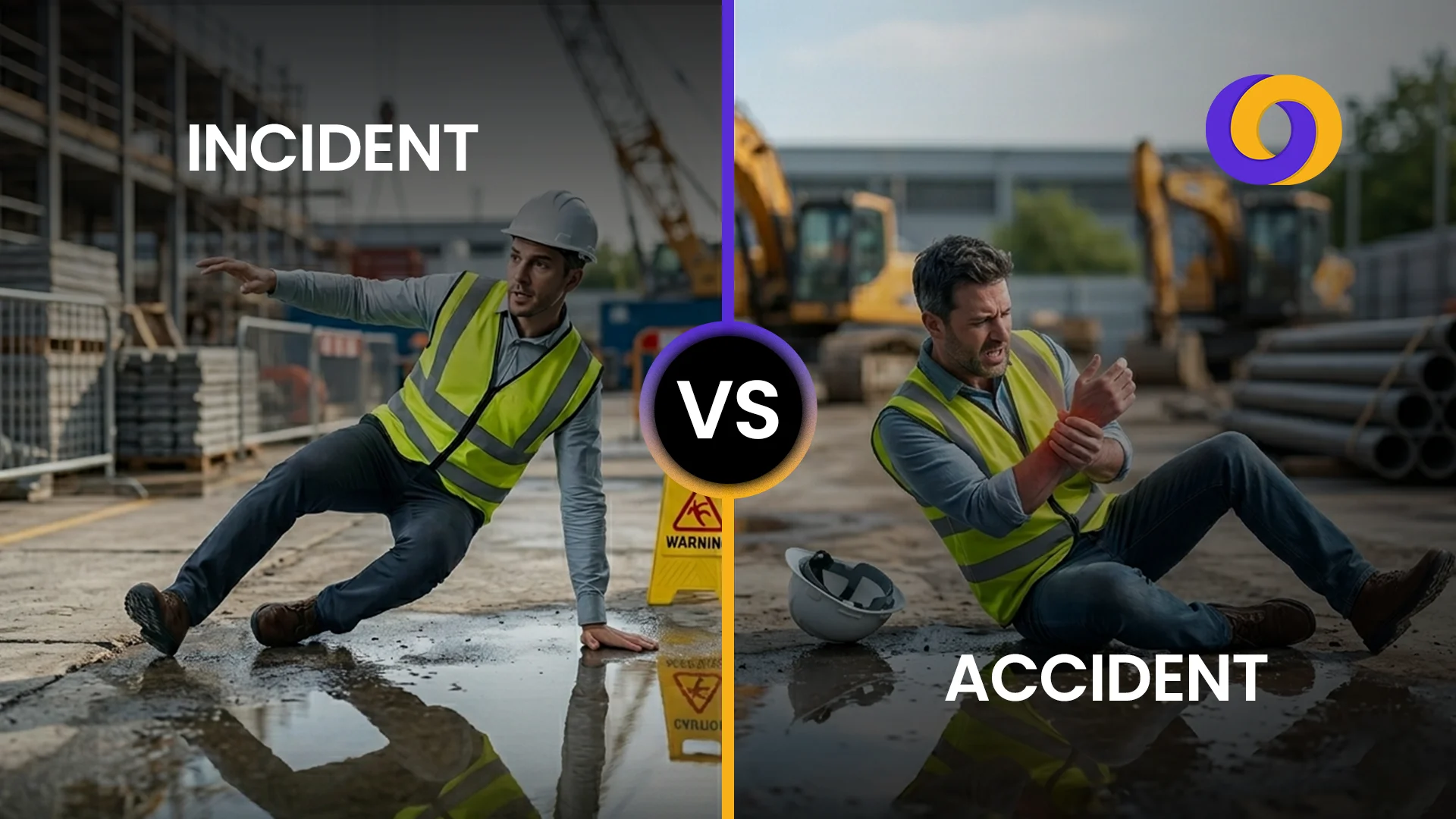
A worker slips on a wet floor but catches themselves. No injury. No damage. Just a close call.
Another worker slips on the same wet floor, falls, and breaks their wrist.
Two events. Same hazard. Same location. Different outcomes.
One is an incident. One is an accident. And how you report each matter more than you think.
For years, many workplaces have treated these terms as interchangeable. But in safety management, compliance, and even legal proceedings, the distinction between an incident and an accident is critical. Misclassifying events can mean missed opportunities to prevent future harm, failed regulatory inspections, and even liability in court.
This guide explains the difference between incidents and accidents, why correct reporting matters, and how to build a safety culture that captures both.
What Is an Accident?
An accident is an unplanned event that results in injury, illness, damage, or loss. The keyword is “result.” Something harmful happened.
Examples of accidents
- An employee falls from a ladder and breaks their leg
- A forklift collides with racking, causing product damage
- A worker burns their hand on hot equipment
- A visitor trips on a loose carpet and sprains their ankle
In each case, harm occurred. Someone was hurt. Something was damaged.
The word “accident” often implies the event was random, unavoidable, or nobody’s fault. This is why many safety professionals prefer other terms—because calling something an accident can discourage investigation into root causes.
What Is an Incident?
An incident is an unplanned event that does not result in injury or damage but has the potential to do so. Incidents are often called “near misses” or “close calls.”
Examples of incidents
- A worker slips on a wet floor but catches themselves
- A ladder wobbles, but the employee climbs down safely
- A tool falls from a height but lands in an empty area
- A fire alarm activates due to a minor fault, with no injuries
No harm occurred. But the potential for harm was real.
Incidents are early warnings. They tell you something in your system is unsafe before someone gets hurt. Ignoring them is like ignoring a smoke alarm because there’s no fire yet.
Incident vs Accident: The Key Difference
Accident | Incident |
Harm occurs (injury, illness, damage) | No harm occurs |
Requires immediate reporting and investigation | Still requires reporting and investigation |
Triggers regulatory notifications (RIDDOR, etc.) | May not trigger formal reporting, but should be logged internally |
Often leads to compensation claims | Prevents future claims by identifying hazards early |
The “what went wrong” after damage | The “what almost went wrong” before the damage |
The simplest way to remember: All accidents are incidents, but not all incidents are accidents.
Why Correct Reporting Matters
1. Prevention of Future Harm
Incidents are free lessons. An accident cost you an injury, damaged equipment, and lost time. An incident cost you nothing—except the opportunity to learn.
When you report and investigate incidents, you identify hazards before they cause harm. That wet floor that caused a near-miss today could cause a broken bone tomorrow. Capturing the near miss allows you to fix the hazard first.
Example: In manufacturing, a worker reports that a guard on a machine is loose (incident). The guard is repaired. Two weeks later, a similar machine’s guard fails catastrophically at another plant, causing a serious injury. The first plant prevented the accident because they reported the incident.
2. Legal and Regulatory Compliance
In the UK, the Reporting of Injuries, Diseases and Dangerous Occurrences Regulations (RIDDOR) require employers to report specific incidents and accidents to the Health and Safety Executive (HSE).
- Reportable accidents: Deaths, specified injuries (fractures, amputations, etc.), injuries that prevent work for more than 7 days
- Reportable incidents (dangerous occurrences): Near-misses with the potential to cause serious harm—like a scaffold collapse, a gas leak, or a lifting equipment failure
Failing to report reportable events is a criminal offence, punishable by fines and, in severe cases, imprisonment.
But beyond legal requirements, correct classification demonstrates due diligence. In the event of a claim or inspection, your reporting records prove you took safety seriously.
3. Identifying Patterns and Root Causes
A single accident is a tragedy. Repeated incidents are a pattern.
When you track incidents alongside accidents, you see trends. Three near-miss slips in the same corridor in one month tell you something about the flooring, cleaning schedule, or footwear policy. A major fall reveals the same information, but only after someone sustains an injury.
Incident data is proactive. Accident data is reactive. Both are essential, but one prevents pain.
4. Reducing Costs
Accidents cost money:
- Sick pay and overtime cover
- Equipment repair or replacement
- Investigation time
- Potential legal fees and compensation
- Increased insurance premiums
Incidents cost very little to report—often just the time to log them. Preventing an accident by acting on incident data saves all the costs above.
5. Building a Positive Safety Culture
When employees see that management takes all events seriously—not just injuries—they become partners in safety, not passive observers.
A worker who reports a near-miss and sees action taken feels valued. A worker who reports a near-miss and hears nothing stops reporting. Over time, that silence creates a culture where only serious events surface—and by then, it’s too late.
Common Mistakes in Incident and Accident Reporting
Mistake 1: Only Reporting Accidents
Near-misses are free warnings. Ignoring them is like deleting security footage because nothing was stolen yet.
Mistake 2: Using Blame Language
“John dropped the box.” Instead: “The box was dropped from height. Why? Was the grip insufficient? Was the box overloaded? Was the stacking unstable?” Language shapes investigation.
Mistake 3: Incomplete Information
“Employee fell.” That’s not a report. What were they doing? What surface? What footwear? What was the outcome? What was the potential outcome? Detail matters.
Mistake 4: No Follow-Up
A report without action is paperwork, not safety. Every incident and accident should lead to a root cause analysis and corrective measures—even if those measures are just retraining or a reminder.
Mistake 5: Delaying the Report
Memory fades. Details blur. Witnesses forget. When an incident or accident occurs, the best time to report it is immediately. A delayed report is an incomplete report. And an incomplete report is as useful as no report at all. Establish a clear rule: all incidents and accidents must be logged before the employee leaves the premises or within one hour of the event, whichever is sooner.
How to Build an Effective Reporting System
1. Make Reporting Easy
If reporting takes 20 minutes of form-filling, people won’t do it. Use simple digital tools (or even paper cards) that capture essential information quickly.
2. Train Everyone on the Difference
Not everyone knows that a near-miss counts as an incident worth reporting. Explain the distinction and why it matters.
3. Investigate, Don’t Blame
The goal of the investigation is prevention, not punishment. A blame culture drives reporting underground.
4. Close the Loop
When someone reports an incident, tell them what you did about it. “Thanks to your report, we’ve fixed the loose handrail.” That feedback encourages future reporting.
5. Review Regularly
Monthly safety meetings should review both incidents and accidents. What patterns are emerging? What actions are pending?
Conclusion
The difference between an incident and an accident isn’t just semantics. It’s a mindset. One focuses on what already happened. The other focuses on what could have happened—and what could still happen if you don’t act.
Organisations that understand this distinction don’t just report more. They prevent more. They protect more. They learn more.
Incidents are gifts. They arrive without cost and offer lessons. Ignore them, and you’ll pay for the same lesson later—with interest.
Accidents demand response. Incidents demand attention. Give both the respect they deserve, and your safety record will thank you.
Simplify Incident Reporting with Smart Workforce
Tracking incidents, accidents, and investigations doesn’t have to be complicated. Smart Workforce helps you log, categorise, and review safety events in one place—ensuring nothing falls through the cracks.
Discover How Smart Workforce Supports Safer Workplaces – Book a Demo Today
Frequently Asked Questions
Do I have to report every near-miss by law?
Not by law. RIDDOR only requires reporting of specific “dangerous occurrences” (near-misses with high potential for serious harm). However, best practice is to report all near-misses internally. They are your best source of preventive information.
Can an incident become an accident?
No. An incident is defined by the absence of harm. If harm occurs, it’s an accident. However, the same hazard can cause incidents (near-misses) repeatedly before finally causing an accident. This is why investigating incidents is so important—they warn you before the accident happens.
What’s the first thing to do after an accident?
Secure the scene. Ensure no further harm. Provide first aid or emergency care. Then preserve evidence (photos, witness details, equipment state). Only then begin formal reporting and investigation. The priority is always people, then paperwork.

0 Comments