
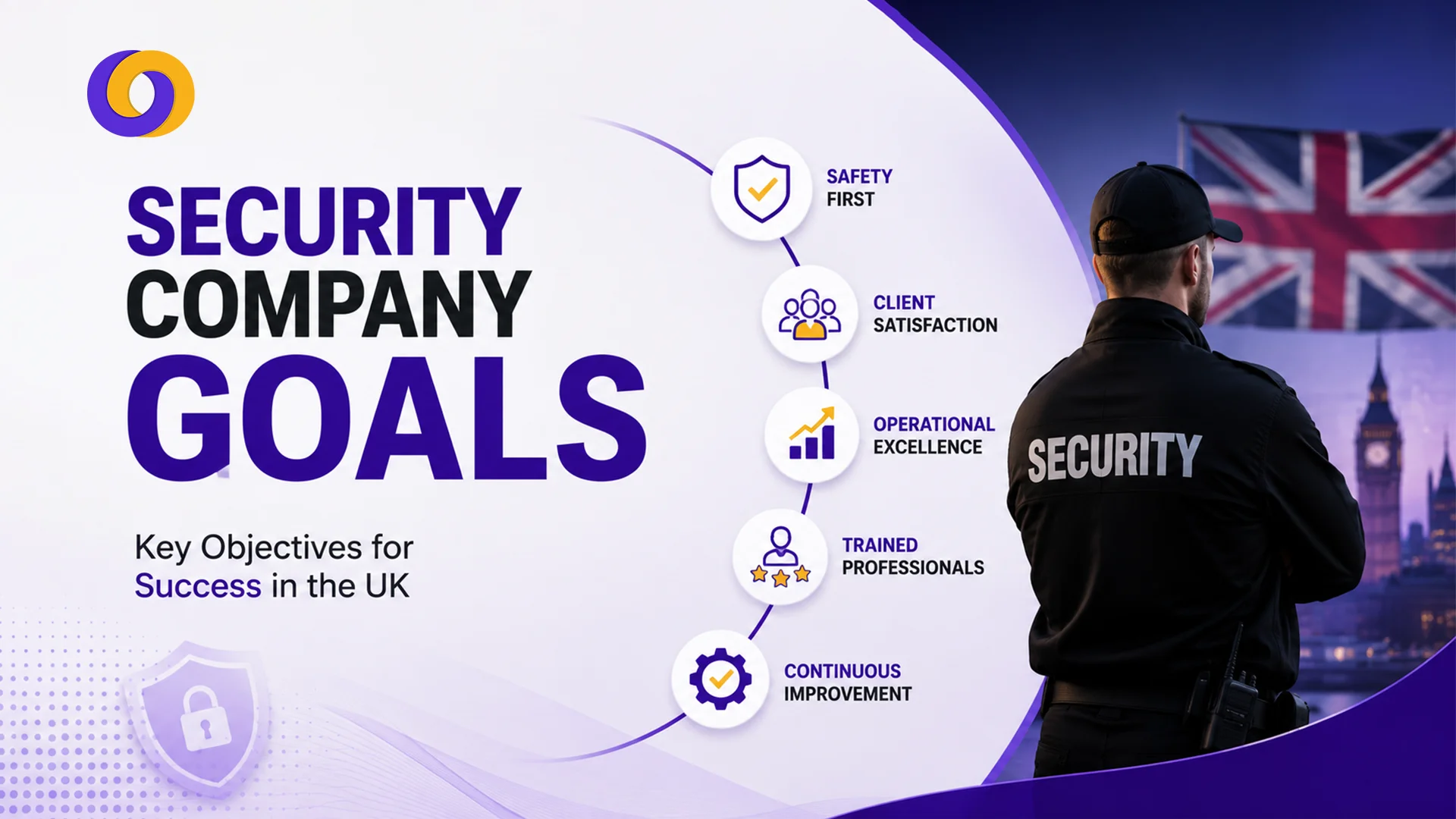
SUMMARY
- Clear objectives improve operational efficiency and client retention. Defined goals align teams, reduce inefficiencies, and build trust with clients.
- Compliance with UK regulations (SIA, BS7858) is non-negotiable. Failure to meet standards results in fines, reputational damage, and contract loss.
- Technology adoption, especially mobile-first tools, is now essential. Real-time tracking, automated reporting, and patrol verification are no longer optional.
- Workforce management directly impacts service quality and profitability. Efficient scheduling, training, and lone worker safety reduce costs and improve performance.
- Data-driven reporting is a major differentiator. Clients demand evidence of service delivery. Automated, branded reports build trust and justify contract renewals.
The UK private security sector is evolving rapidly. According to the Security Industry Authority (SIA), over 450,000 licensed security operatives are currently active. This figure has grown steadily as demand increases across construction, retail, critical infrastructure, and events. At the same time, staff shortages, rising client expectations, and stricter compliance requirements are pushing companies to operate more efficiently and transparently.
In this environment, simply “providing security” is no longer enough. Clients demand evidence of service delivery. Regulators require auditable compliance. Employees expect safety, fair scheduling, and career progression. To stay competitive, security firms must move beyond basic service delivery and align their strategy with clearly defined, measurable goals.
This guide outlines the key objectives every UK security company must prioritise in 2026, backed by industry insights and practical recommendations.
Why Defined Goals Matter in the UK Security Industry
Security companies operate in a high-stakes environment where accountability, reliability, and compliance are critical. Without structured goals, businesses risk inefficiencies, compliance breaches, client dissatisfaction, and ultimately, contract loss.
Strong security company objectives provide:
- Direction for teams
Guards, supervisors, and managers know what’s expected and how their work contributes to broader success.
- Measurable performance benchmarks
Goals allow you to track progress, identify gaps, and celebrate wins.
- Alignment between operations and client expectations
When your team understands client priorities, service delivery improves.
Industry reality: The SIA’s Approved Contractor Scheme (ACS) now expects digital systems for vetting, training, supervision, and compliance. Manual processes no longer meet the standard.
Core Objectives of a Security Company
A security company’s core objectives must balance regulatory compliance, operational excellence, client satisfaction, and workforce welfare to remain competitive in the UK market. These objectives provide the strategic framework that guides daily operations, shapes technology investments, and ultimately determines whether a firm wins or loses contracts. The objectives are:
1. Ensure Full Regulatory Compliance
Compliance is the foundation of any UK security operation. Companies must adhere to:
- SIA licensing requirements
All frontline staff must hold valid SIA licences. Expired licences mean non-compliance and inability to work.
- BS7858 vetting standards
The British Standard for screening individuals working in secure environments. Clients increasingly mandate it as a condition of service.
- Working Time Regulations
Rest breaks, 48-hour weekly limits, and 11-hour daily rest periods must be tracked and enforced.
Failure to meet these standards can result in fines, reputational damage, or loss of contracts. From 1 April 2026, the SIA licence renewal fee reverts to £204 after the temporary £20 rebate ends, making compliance tracking even more important for workforce planning.
Action: Implement an automated system to track SIA expiry dates, BS7858 vettinghttps://smartworkforce.co.uk/benefits-of-workforce-planning/ status, and working time compliance.
2. Deliver Consistent Service Quality
Clients expect visible, reliable, and professional service delivery. This includes:
- Timely patrols
Guards must complete patrols on schedule, with verifiable proof of completion.
- Accurate incident reporting
Incidents must be logged promptly with photos, videos, and detailed descriptions.
- Professional guard conduct
Appearance, communication, and behaviour must meet client expectations.
Clearly defined objectives of a security company should always prioritise service consistency and accountability. Clients who receive inconsistent service are more likely to tender contracts elsewhere.
Action: Use a guard patrol system with QR checkpoint scanning to verify patrol completion and generate automated client reports.
3. Optimise Workforce Performance
Security operations rely heavily on frontline staff. Efficient workforce management ensures:
- Proper shift coverage
No gaps in service due to last-minute absences or poor scheduling.
- Reduced overtime costs
Real-time visibility of hours worked prevents budget creep.
- Improved staff satisfaction
Fair scheduling, predictable rotas, and lone worker safety features improve retention.
This is where clearly defined security guard responsibilities become essential. Guards must understand expectations around patrols, reporting, and client interaction. Without clarity, performance suffers.
Action: Invest in workforce management software that integrates scheduling, time and attendance, and lone worker safety.
4. Improve Client Retention and Satisfaction
Winning contracts is expensive. Retaining them is critical.
Companies should aim to:
- Provide transparent reporting
Clients want evidence of service delivery, not just promises.
- Maintain regular client communication
Proactive updates build trust and prevent surprises.
- Demonstrate measurable value
Use data to show how your service reduces risk, improves safety, or saves money.
Automated reporting and performance dashboards can significantly improve client trust. When clients can see exactly what they’re paying for, they’re far less likely to switch providers.
Action: Offer client portals where they can view patrol logs, incident reports, and guard attendance in real time.
5. Use Technology for Operational Efficiency
Modern security companies are increasingly tech-driven. Key tools include:
- Mobile patrol apps
Guards log patrols, incidents, and clock-ins from their phones.
- Real-time GPS tracking
Supervisors see guard locations on live dashboards.
- Automated reporting systems
Client-ready reports are generated instantly, eliminating manual report writing.
A guard patrol system enables:
- Proof of service delivery – Clients see exactly when and where patrols were completed.
- Reduced manual errors – No more illegible handwriting or lost paper logs.
- Real-time monitoring – Control rooms can respond to incidents as they happen.
Action: Replace paper logs with a mobile-first guard patrol system that works offline and syncs automatically.
6. Enhance Lone Worker Safety
Lone worker protection is both a legal and ethical responsibility. Under the Health and Safety at Work Act, employers must monitor lone workers and respond to incidents.
Objectives should include:
- Automated check-ins
Guards confirm their safety at scheduled intervals.
- Panic alerts
One-touch SOS buttons with GPS location sharing.
- Real-time location tracking
Supervisors know where lone workers are at all times.
Action: Implement lone worker safety features, automated check-ins, panic alerts, and GPS tracking, to protect staff and reduce liability.
7. Drive Profitability and Cost Efficiency
Operational efficiency directly impacts margins. Key focus areas:
- Reducing administrative workload
Automation eliminates manual data entry and report writing.
- Minimising scheduling conflicts
Real-time visibility prevents overstaffing and understaffing.
- Automating repetitive tasks
Shift reminders, attendance tracking, and client reporting should be automated.
Companies that streamline operations can scale more effectively, win more contracts, and improve margins.
Action: Automate scheduling, time and attendance, and client reporting to reduce admin time by up to 70%.
The Role of Technology in Achieving Security Goals
Technology is no longer optional. It is central to achieving modern security objectives.
Leading companies use integrated platforms to:
- Manage scheduling and attendance
Real-time visibility of who is working, where, and when.
- Track guard movements in real time
GPS and QR checkpoint scanning provide proof of patrol completion.
- Generate client-ready reports automatically
Branded, automated reports build trust and justify contract renewals.
Example: A security company using Smart Workforce reduced scheduling time by 70%, eliminated paper logs, and improved client retention through automated reporting.
The bottom line: Technology transforms security operations from reactive to proactive, from paper-based to digital, and from opaque to transparent.
Common Challenges Security Companies Face
Even with clear goals, companies often struggle with:
Challenge | Impact | Solution |
Staff shortages and high turnover | Inconsistent service, increased agency spend | Fair scheduling, career progression, lone worker safety |
Manual processes leading to errors | Payroll mistakes, lost patrol records, compliance gaps | Automate scheduling, time tracking, and reporting |
Lack of real-time visibility | Delayed response to incidents, poor client communication | Real-time GPS tracking and dashboards |
Increasing compliance requirements | Risk of fines and contract loss | Automated compliance tracking (SIA expiry, BS7858, WTR) |
Addressing these challenges requires a combination of strategy, training, and technology. Manual processes no longer cut it.
How to Set Effective Security Company Goals
To ensure success, goals should be:
- Specific
Clearly defined outcomes (e.g., “achieve 100% patrol completion rate”).
- Measurable
Trackable metrics (e.g., response time, patrol completion rates, client satisfaction scores).
- Achievable
Realistic based on resources (e.g., start with one site, scale across all sites).
- Relevant
Aligned with business and client needs (e.g., focus on the metrics clients care about).
- Time-bound
Set within a defined timeframe (e.g., “achieve X by Q3 2026”).
Example goal: “Reduce scheduling time by 50% and eliminate paper patrol logs by implementing a guard patrol system within 3 months.”
Conclusion
The UK security industry is becoming more demanding, regulated, and technology-driven. Companies that define and execute clear objectives—focused on compliance, workforce efficiency, client satisfaction, and innovation—are best positioned for long-term success.
Your 2026 security company checklist:
- Ensure full SIA and BS7858 compliance
- Implement a mobile-first guard patrol system
- Provide lone worker safety features
- Automate client reporting
- Reduce admin time through workforce management software
- Set specific, measurable, time-bound goals
By aligning operations with strategic goals, security firms can not only meet industry standards but exceed client expectations and gain a competitive edge.
How Smart Workforce Helps Security Companies Achieve Their Goals
Smart Workforce is an all-in-one platform designed specifically for UK security companies. It helps you achieve the key objectives outlined in this guide:
Objective | How Smart Workforce Helps |
Regulatory compliance | Track SIA expiry dates, BS7858 vetting status, and Working Time Regulations automatically |
Consistent service quality | QR checkpoint scanning, real-time patrol verification, automated client reports |
Workforce performance | Drag-and-drop scheduling, GPS time and attendance, shift swaps |
Client retention | Branded, automated client reports with proof of service delivery |
Technology adoption | Mobile-first platform with offline mode, GPS tracking, and real-time dashboards |
Lone worker safety | Automated check-ins, panic alerts, fall detection |
Profitability | Reduce admin time by 70%, eliminate paper logs, cut agency spend |
Discover How Smart Workforce Can Help You Achieve Your Security Company Goals – Book a Demo Today
Frequently Asked Questions
What are the main goals of a security company?
The main goals include ensuring safety, maintaining compliance with SIA and BS7858, delivering reliable services, retaining clients through transparent reporting, and leveraging technology for operational efficiency.
Why is compliance important in the UK security industry?
Compliance with SIA licensing and BS7858 vetting standards ensures legal operation, builds trust with clients, prevents fines, and is often a contractual requirement for high-value contracts.
How can security companies improve efficiency?
By adopting technology like scheduling software, patrol tracking with QR checkpoints, automated reporting, and lone worker safety features. Thus, reducing admin time and eliminating paper-based processes.
What role does technology play in security operations?
Technology enables real-time tracking, reduces manual errors, automates client reporting, improves compliance tracking, and provides proof of service delivery. All of this differentiate winning companies.
How do security companies retain clients?
Through consistent service delivery, transparent reporting, regular communication, and demonstrating measurable value, all supported by automated, branded reports that show exactly what clients are paying for.
What challenges do UK security companies face?
Key challenges include staff shortages, increasing compliance requirements, manual processes leading to errors, lack of real-time visibility, and high turnover. This can be addressed through strategy and technology.
How can security companies ensure guard safety?
By implementing lone worker protection features such as GPS tracking, automated check-ins, panic alerts, and fall detection. Hence, protecting staff and reducing liability.

0 Comments