
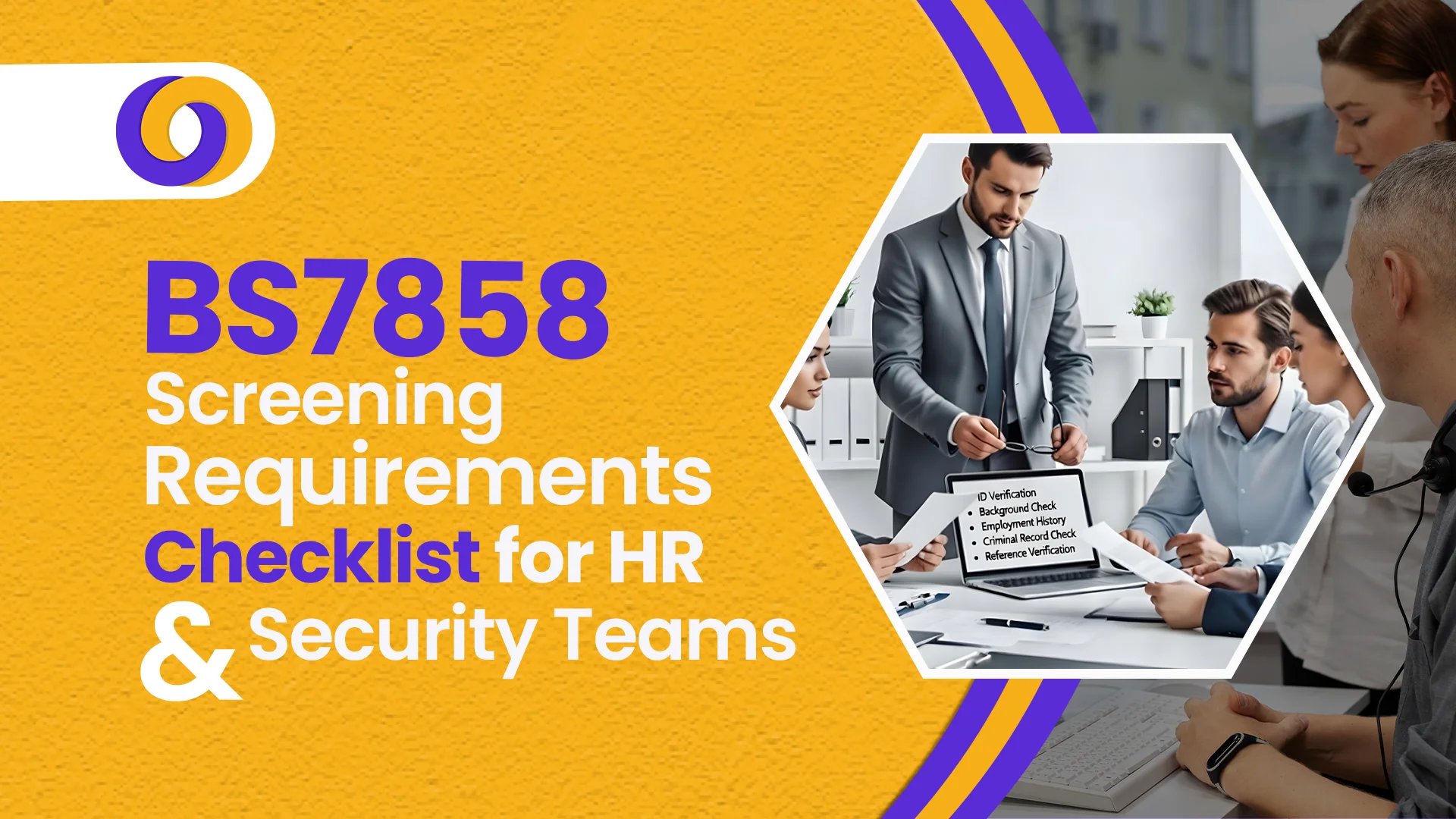
Traditional background checks are simply insufficient when the security of your company depends on the integrity of your staff. Higher levels of vetting are necessary for security guards watching sensitive data, employees in jobs where security breaches might have severe ramifications, staff with unescorted access to limited areas, or those handling sensitive information.
It is crucial for HR specialists and security teams in charge of enforcing these standards to know precisely what BS7858 includes and how to implement it correctly.
This comprehensive guide helps you create strong screening procedures that safeguard your company while still complying with UK law by offering a workable checklist spanning every element ofBS7858 screening.
What is BS7858?
BS7858 is the British Standard for security screening of those working in a security environment. Originally designed for the security sector, its ideas now apply to any business where workers have access to information, assets, or property needing protection.
Fundamentally, BS7858 is more than just a checklist. It’s a framework demanding recorded processes, audit trails, secure record-keeping, and periodic reviews. Your company shows seriousness about security and has adopted internationally acknowledged screening procedures by means of compliance.
Who Needs BS7858 Screening?
BS7858 screening is typically required for:
- Security personnel: Close protection agents, door supervisors, security officers, and guards are among the security staff. For several licenced security jobs, the Security Industry Authority (SIA) calls for BS7858-compliant screenings.
- Facilities management staff: Particularly in delicate sectors like finance, government, healthcare, or crucial national infrastructure, facilities management personnel with unescorted access to client premises.
- Aviation security roles: Where CAA standards call for extensive background checks for anybody permitted access to confined airport areas or aircraft.
- Staff handling sensitive information: Employees dealing with sensitive data include IT administrators, records managers, or anyone frequently accessing private or personal information.
- Government contractors and vendors: Where contracts stipulate BS7858 compliance as the least security requirement for employees.
- Critical infrastructure positions: Energy, water, telecommunications, or transportation critical infrastructure locations where security breaches might have serious public safety consequences.
Though not legally required, several companies choose BS7858 for important jobs since it denotes best practice in security screening.
The Complete BS7858 Screening Checklist
1. Identity Verification
Confirming candidates as who they claim to be forms the basis for all following investigations. Using authentic documentation from designated lists, BS7858 demands confirmation.
- Primary identification documents include valid passports or national identity cards that confirm name, date of birth, and usually include a picture.
- Secondary documentation Particularly when names have changed, secondary documents like birth certificates, marriage certificates, or adoption certificates may be needed to prove identity history.
- Proof of address Confirmation of present home address comes from evidence of address in the form of official letters, bank statements, council tax bills, or recent utility statements. Papers should be no older than three months.
- Photographic evidence During the verification process, photographic evidence must be recorded. Make sure photographs are of good quality for later reference by taking a crisp picture of the candidate and copies of all papers reviewed.
All documents must be original; photocopies are not allowed. To find forgeries, examiners must physically handle documents, examining security elements such as watermarks, holograms, or unique paper.
2. Employment History Verification
For the past five years minimum, complete employment history, including all periods, must be verified, with explanations of any gaps beyond 28 consecutive days.
- Contact previous employers directly Direct contact with former employers instead of depending on candidate-supplied letters or emails. Rehire eligibility, employment dates, job titles, and reason for leaving must all be verified.
- Document gaps thoroughly One must describe unemployment, travel, schooling, caregiver duties, or sickness and, where practical, prove it with supporting documents.
- Self-employment verification Calls for tax returns, corporate registration papers, client contracts, or professional body memberships.
- Overseas employment Overseas jobs provide other difficulties. Though these involve more risk, alternative proof might comprise contracts, payslips, or statutory declarations when UK-style references are not available.
Keep thorough records documenting efforts to reach referees, answers received, and any inconsistencies between applicant claims and confirmed data.
3. Right to Work Verification
Verifying UK legal entitlement to work is both a BS7858 need and a legal responsibility. This check shows due diligence and prevents illicit labour.
- Check original documents: Examine the original Home Office prescribed list documents. Usually with passports are British and Irish nationals. Non-EEA citizens need documentation confirming job permission.
- EU, EEA, and Swiss citizens: Usually needing settled or pre-settled status under the EU Settlement Scheme, European, EEA, and Swiss nationals who arrived after December 2020 should have their status confirmed via the Home Office online checking service using their share code.
- Copy and date documents: Evidence of your checking, copying, and dating papers; keep copies safely. For time-limited authorizations, diarize follow-up inspections prior to expiration of the permission.
- Conduct checks before employment begins: Avoid hiring undocumented employees—which entails fines up to £20,000 per illegal worker—by first performing employment checks.
4. Criminal Record Checks
Although the right degree varies depending on the particular job and industry, criminal history checking is fundamental to BS7858.
- Basic DBS checks: Most BS7858 screening requires at least basic DBS checks revealing unspent convictions. These are appropriate for regular security tasks, not including underprivileged people.
- Standard or enhanced DBS checks: Some positions—particularly those involving regulated activity with youngsters or vulnerable adults or where mandated by industry rules—may call for standard or enhanced DBS examinations.
- Overseas criminal record checks: Applicants who have resided abroad for six months or more in the last five years need overseas criminal history checks. As different countries have different disclosure systems and some don’t offer employers checks at all, these examinations can be difficult and time-consuming.
Record the check level completed, certificate number, date of issue, and any revealed information. Only the essential information should be noted; never keep actual DBS certificates.
5. Address History Verification
A minimum of five years of full residential address history must be recorded and, if at all feasible, confirmed. This need helps verify stability and find possible problems.
- Electoral roll checks Though not everyone seems to be on publicly accessible versions, electoral roll checks can confirm addresses.
- Credit reference data Though this method demands explicit permission and brings up data privacy issues, credit reference information could show address history.
- Documentary evidence When other techniques fail, documentary proof like tenancy agreements, mortgage statements, or utility bills helps to check address history.
- Gaps in address history Address history gaps must be clarified. Periods of homelessness, temporary housing, or living with friends or family should be recorded along with reasons.
6. Gap Analysis and Timeline Verification
BS7858 requires account for all time periods in the five-year lookback. Gaps exceeding 28 days require investigation and explanation.
- Create a comprehensive timeline showing employment, unemployment, education, travel, and other activities covering the full five-year period.
- Investigate discrepancies between what candidates claim and what verification reveals. These might indicate dishonesty or simply memory lapses, but all must be resolved satisfactorily.
- Document explanations for gaps, obtaining supporting evidence where possible—travel documents, medical records (with consent), education enrollment confirmations, or statutory declarations.
7. Social Media and Online Checks
Many companies now include online presence screening as part of thorough vetting even if BS7858 does not expressly demand it.
- Search for publicly available information Find openly accessible information that might point to suitability issues—associations with extremist groups, proof of deception, or behaviour unsuitable for security-sensitive positions.
- Be cautious about discrimination risks Watch for discrimination hazards. Online information frequently exposes protected traits that shouldn’t affect employment choices.
- Document what you search for and what you find Record your searches and results to guarantee consistency across applicants and defensibility in case of decision challenges.
8. Qualification and License Verification
Where roles require specific qualifications, licenses, or certifications, these must be verified directly with issuing bodies.
- SIA licenses for security personnel can be verified through the SIA online checker using license numbers.
- Professional qualifications should be confirmed with awarding institutions or professional bodies directly.
- Driving licenses for roles requiring driving should be verified through DVLA checking services with candidate consent.
Never rely solely on certificates or documents provided by candidates, as these can be forged.
9. Financial Probity Checks
For positions involving financial responsibility or where financial pressures could create security risks, credit checks may be appropriate.
- County Court Judgments, bankruptcy, and insolvency Information appears on credit reports and might indicate financial stress that could make individuals vulnerable to bribery or theft.
- Conduct proportionate checks Financial history checks must be justified by genuine job requirements and conducted with explicit candidate consent.
- Consider context Financial difficulties don’t automatically disqualify candidates—assess whether specific issues create genuine security risks.
Final Thoughts
BS7858 is a gold standard for evaluating people in security-sensitive jobs. Though comprehensive and demanding, correct execution shields your company, your clients, and the public from security risks missed by insufficient screening.
The foundation for creating strong BS7858-compliant screening procedures is provided by this list. Systematic processing of every component—identity verification, employment history, criminal records, address verification, reference checks, and all other elements—generates defensible vetting that withstands audit and legal inspection.
Need help implementing BS7858 screening? Discover how Smart Workforce can simplify your BS7858 compliance whilst strengthening your security posture.
Contact us today for a consultation.
Frequently Asked Questions
How long does BS7858 screening typically take?
BS7858 screening usually takes 4-8 weeks, though timelines vary based on candidate history complexity.
What happens if a candidate fails BS7858 screening?
“Failure” isn’t always straightforward—findings require assessment rather than automatic rejection. Serious issues like identity fraud, undisclosed criminal history, or dishonesty typically disqualify candidates. Always give candidates the opportunity to explain findings before making final decisions.
Is BS7858 screening legally required?
BS7858 compliance is legally mandated for certain SIA-licensed security roles and specified in many government and critical infrastructure contracts. For other positions, it’s not legally required but represents industry best practice for security-sensitive roles.

0 Comments