
“Did you send that email?”
“I thought you were handling it.”
“Hang on—no one told me the deadline moved.”
If these conversations sound painfully familiar, you’re not alone. These aren’t just annoying little workplace mix-ups. They’re symptoms of a genuinely expensive problem: interaction breakdowns that quietly drain productivity, tank morale, and cost your business actual money.
How much money? According to a 2024 study by Grammarly and The Harris Poll, poor communication costs large UK organisations an average of £15,000 per employee per year in lost productivity, missed deadlines, and rework.
Yet most managers still treat communicating as “soft skills”—nice to have but not essential. In 2026, with hybrid teams, generational diversity, and AI-powered workflows, correspondence hurdles have multiplied. Understanding and overcoming them isn’t optional. It’s a competitive necessity.
This guide identifies the top communication barriers in UK workplaces and provides actionable strategies to overcome them, drawing on evidence-based research and real-world case studies.
Why Communication Barriers Matter
Before we get into specific obstacles, let’s talk about what happens when conversation goes wrong:
| Impact Area | What It Costs You |
| Productivity loss | £15,000+ per employee annually (Grammarly, 2024) |
| Project delays | 28% of projects delayed due to misinterpretation |
| People quitting | 33% of employees have left a job due to poor exchange of ideas |
| Angry customers | 70% of client complaints stem from interaction failures |
| Safety incidents | 25% of workplace accidents involve dealing gaps |
These aren’t abstract statistics. This is real money walking out your door, real deadlines being missed, real people getting frustrated enough to update their CVs, and real accidents that could’ve been prevented.
The 7 Communication Barriers
Discussed below are the top hurdles that organisations face and are reducing the productivity at workplace.
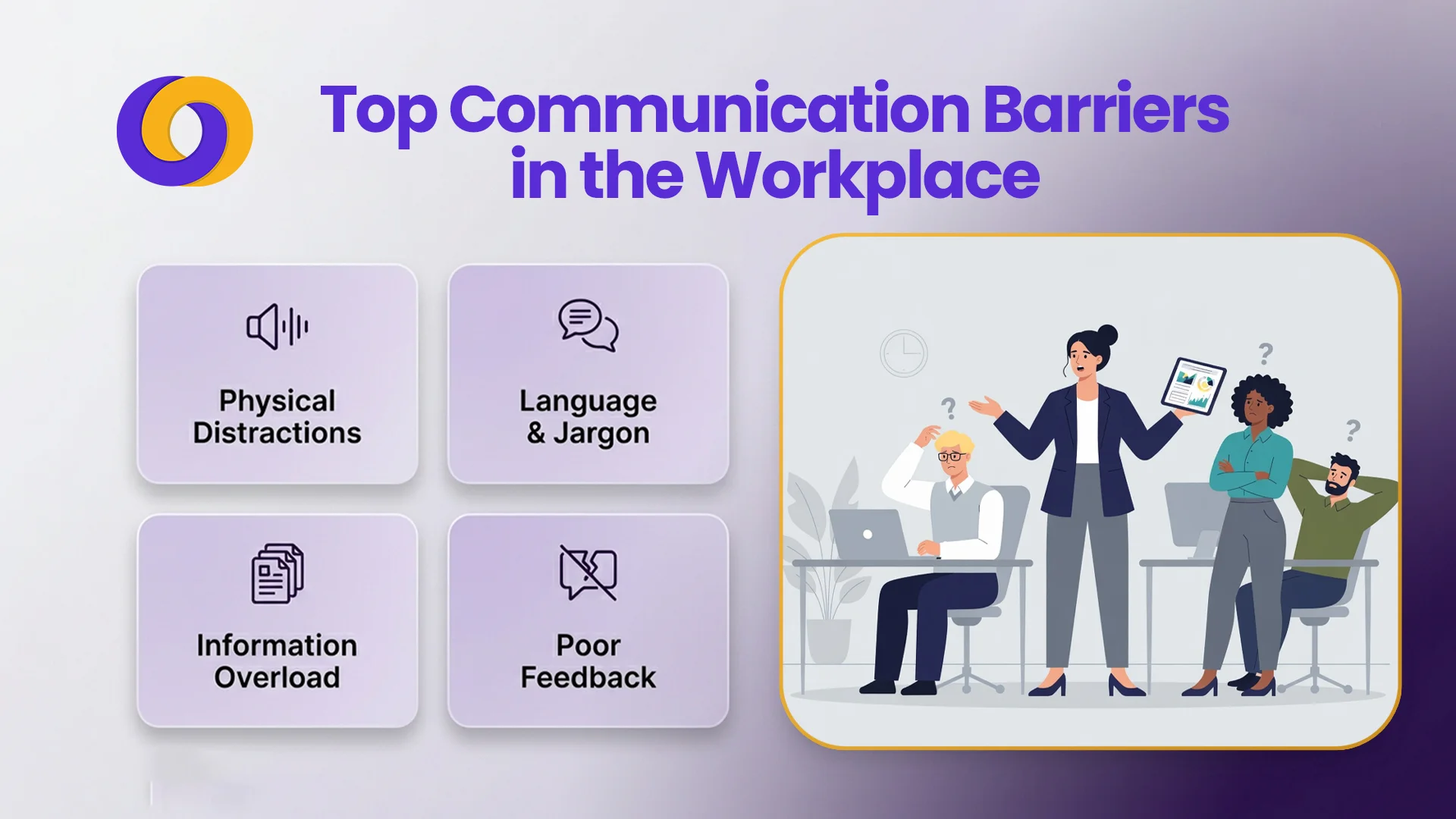
1. Physical and Environmental Distractions
(“Why Can Nobody Focus Anymore?”)
What it looks like:
Open-plan offices where you can hear Gary’s entire phone conversation with his mum. Remote workers whose WiFi drops out mid-meeting. Factory floors so loud you need to shout. Email notifications pinging every 30 seconds like some sort of digital water torture.
Why it’s a problem:
Your brain can’t multitask. Sorry, but it can’t. Research shows that after getting distracted, it takes an average of 23 minutes and 15 seconds to properly refocus on what you were doing. Twenty-three minutes! And the average worker faces 50-60 interruptions daily. Do the maths—that’s most of your day spent trying to remember what you were doing before someone interrupted you.
How to fix it:
- Create “focus zones” in your office—quiet areas where Gary’s personal calls aren’t allowed
- Block out “no-meeting” times (like 10am-12pm) where people can concentrate
- Use asynchronous transmission for stuff that isn’t urgent (not everything needs an immediate reply)
- Invest in decent noise-cancelling headphones for desk workers
- If you’ve got remote teams, set “availability hours” and respect them
2. Language and Jargon
(“Why Does Nobody Speak English Anymore?”)
What it looks like:
Your finance manager starts banging on about “EBITDA” to a graphic designer who hasn’t got a clue what that means. IT says, “we need API integration” and sales just nods along pretending to understand. A new hire from another country is utterly baffled by phrases like “touch base” or “circle back” (and honestly, fair enough—what do those even mean?).
Why it’s a problem:
Over 10% of UK workers now have English as a second language, according to ONS data. And even native English speakers struggle with industry-specific acronyms and internal company jargon. You’re not being clever by using complicated terms—you’re just confusing people.
How to fix it:
- Create a “jargon buster” document for new hires (and be honest about how ridiculous some of it sounds)
- Train managers to check understanding: “Can you summarise what I’ve just asked?” (Not in a patronising way. Just… checking.)
- Stop using acronyms in writing unless you define them first
- Write policies in plain English, not corporate nonsense
- Get language training or translation tools for multilingual teams
3. Hierarchical and Power Dynamics
(“The Boss Said It, So It Must Be Right”)
What it looks like:
Junior staff spotting a mistake in the senior manager’s presentation but staying quiet because “they probably know what they’re doing.” A warehouse worker noticing a safety risk but assuming “management knows best.” Meetings where the loudest voice—usually the most senior person—dominates, and everyone else just sits there nodding.
Why it’s a problem:
Psychological safety—the belief that you won’t get bollocked for speaking up—is directly linked to team performance. Google’s famous Project Aristotle study found that psychological safety was the single most important factor in high-performing teams. Not talent. Not resources. Safety to speak up.
Hierarchical barriers destroy that completely.
How to fix it:
- Leaders need to show vulnerability: “I genuinely don’t know. What do you lot think?”
- Create anonymous feedback channels for sensitive stuff
- Rotate who runs meetings so it’s not always the boss
- Explicitly ask junior staff for input: “Sarah, what’s your take on this?”
- Train managers in inclusive leadership and listening (not just waiting for their turn to talk)
4. Cultural and Generational Differences
(“Why Can’t Everyone Just Communicate Like Me?”)
What it looks like:
A Baby Boomer manager who wants face-to-face meetings for everything. A Gen Z employee who’d rather message on Slack than talk to anyone ever. Direct feedback that some cultures see as refreshingly honest and others experience as shockingly rude. Indirect feedback that seems polite to some and maddeningly vague to others.
Why it’s a problem:
UK workplaces now span up to five generations and dozens of nationalities. Each brings completely different discourse norms, ways of handling conflict, and preferences for giving and receiving feedback. Without awareness, these differences create friction, resentment, and messages that get totally lost in translation.
How to fix it:
- Create a “correspondence preferences” document where people can say, “I prefer email,” or “just call me.”
- Train teams on cultural intelligence—not just a tick-box exercise, actual useful stuff
- Agree team norms for response times and which channels to use for what
- Don’t assume intent—if a message feels off, just ask: “Can you help me understand what you meant?”
- Celebrate diversity instead of trying to make everyone talk the same way
5. Information Overload
(“I’m Drowning in Messages and Nobody Cares”)
What it looks like:
200 unread emails by lunchtime. Messages scattered across Slack, Teams, WhatsApp, email, and probably a WhatsApp group you forgot existed. Meetings back-to-back with zero time to process what was said. Important updates buried in 47-message threads that nobody has time to read.
Why it’s a problem:
The average UK worker receives 120-150 emails daily. When information is everywhere, it’s effectively nowhere. Critical updates get missed. Deadlines slip through the cracks. People burn out from “notification fatigue”—that constant anxiety that you’re missing something important somewhere.
How to fix it:
- Establish channel discipline: Slack for urgent stuff, email for formal things, Teams for specific projects
- Try “no internal email Fridays” or similar boundaries (it sounds gimmicky but it works)
- Use meeting agendas and summaries so information isn’t scattered across verbal conversations nobody remembers
- Limit meeting attendees to people who need to be there
- Train people on inbox management and how to turn off those bloody notifications
6. Emotional and Psychological Barriers
(“Everyone’s Stressed and It Shows”)
What it looks like:
An employee worried about redundancies who interprets every piece of feedback as criticism. A manager stressed about a client deadline who snaps at their team over something minor. A team member who feels undervalued and just… stops contributing ideas. Why bother, right?
Why it’s a problem:
Emotions filter absolutely everything we hear and speak. Stress, anxiety, burnout, job insecurity—they all distort messages, escalate conflicts, and shut down contact completely. According to the Health and Safety Executive, work-related stress accounted for 17 million lost working days in 2023/24. That’s not just individual suffering—that’s organizational dysfunction.
How to fix it:
- Train managers in emotional intelligence (not just “be nicer”—actual skills)
- Build regular well-being check-ins into one-to-ones
- Make it normal to talk about mental health: “How are you really feeling?”
- Provide proper employee assistance programs, not just a leaflet nobody reads
- Address the root causes of stress: unrealistic workload, lack of clarity, no control, insufficient support
7. Poor Feedback Culture
(“Nobody Tells Me Anything Until the Annual Review”)
What it looks like:
Annual performance reviews where employees hear criticism for the first time and think “why didn’t you tell me this in March?!” Managers avoiding difficult conversations until problems become unmanageable. Praise so generic—”good job!”—that it’s basically meaningless.
Why it’s a problem:
Without regular, specific, actionable feedback, people don’t know what they’re doing well or what needs improving. Mistakes keep happening. Resentment grows. According to Gallup, only 26% of UK employees strongly agree that feedback helps them do better work. That’s appalling.
How to fix it:
- Bin the annual review nonsense and do regular check-ins (weekly or bi-weekly)
- Use frameworks like SBI (Situation-Behaviour-Impact) for specific feedback, not vague feelings
- Separate coaching conversations from performance ratings—they’re different things
- Ask for feedback as a manager: “What could I do differently?” (and listen to the answer)
- Celebrate wins publicly and address problems privately and quickly
A Practical Framework for Diagnosing Communication Barriers
When discourse fails, use the DEAR framework to diagnose and fix it:
| Step | Question | Action |
| D – Define | What specifically went wrong? | Get specific. “Communication is bad” is useless. “The deadline was missed because the email went to spam” is fixable. |
| E – Explore | What barriers are at play? | Match the failure to the 7 barriers above. Usually it’s more than one. |
| A – Act | What’s one change we can make right now? | Start small. One fix at a time. Don’t try to solve everything. |
| R – Review | Did it work? What’s next? | Correspondence improvement is ongoing, not a one-off project. |
The Role of Technology
Technology isn’t a silver bullet, but the right tools help:
| Barrier | Technology Solution |
| Information overload | Slack channels, Teams tags, email filters |
| Physical distractions | Focus mode apps, noise-cancelling headphones |
| Language differences | Real-time translation (Microsoft Translator, DeepL) |
| Feedback culture | Continuous feedback platforms (15Five, Culture Amp) |
| Remote coordination | Project management tools (Asana, Trello, Monday) |
| Tracking | Read receipts, message analytics |
Warning: Technology can also create obstacles. Too many channels, notification overload, and asynchronous misunderstandings are real risks. Use tools intentionally, not because everyone else is using them.
How Smart Workforce Helps
Effective interaction needs clear structures, shared visibility, and reliable information. Our solution helps UK security and service sector employers by putting schedules, attendance, and leave requests in one place. No more chasing rotas via WhatsApp. No more leave requests lost in email chains. Just… everyone knowing what’s happening.
Discover How Smart Workforce Improves Team Communication – Book a Demo Today
Conclusion
Communication barriers aren’t some inevitable facts of working life. There are problems. Problems can be solved.
First step: awareness. Which barriers are affecting your team? Not all seven—probably two or three main culprits.
Second step: action. Small, consistent changes that build a culture where people understand each other, feel safe speaking up, and have the information they need when they need it.
In 2026’s messy, hybrid, diverse workplaces, good communication isn’t a “soft skill.” It’s a competitive advantage. The organizations that invest in overcoming barriers will run circles around those that just accept them as “the way things are.”
Your choice.
FAQs
What is the most common communication barrier in UK workplaces?
Information overload is increasingly the biggest problem, with the average worker receiving 120-150 emails daily plus messages across multiple platforms (Slack, Teams, WhatsApp, you name it). This scatters attention, buries critical updates, and contributes massively to burnout. It’s not just annoying—it’s genuinely damaging productivity.
How can I measure communication effectiveness in my team?
Track actual metrics: project completion rates, meeting satisfaction surveys, employee engagement scores, time-to-resolution for client complaints, and anonymous feedback on “Do you feel heard at work?” Compare these before and after you make changes. Numbers don’t lie—survey responses sometimes do, but trends are revealing.
Can remote work cause more communication barriers than office work?
Remote work creates different barriers, not necessarily more. You lose casual hallway chats and quick desk drop-bys. But with clear protocols, remote teams often communicate more deliberately and document things better than office-based teams who rely on “I’ll just tell them in person” (and then forget). It’s about intentionality, not location.
How do I give constructive feedback without damaging morale?
Use the SBI framework: describe the Situation (when and where it happened), the Behaviour (what you observed, factually), and the Impact (how it affected the team or project). Avoid judgment words like “lazy” or “careless.” Ask for their perspective before jumping to solutions. Most importantly: do it promptly, not months later in a review.
What’s the fastest way to improve team communication today?
Run a 20-minute team meeting and create a “communication norms” agreement together. Answer three questions:
(1) What channels do we use for what?
(2) How quickly do we expect responses?
(3) What’s our protocol for genuinely urgent messages?
This single dialogue eliminates most day-to-day confusion immediately.

0 Comments