
From hospitals and manufacturing facilities to emergency dispatch centres, the search for the ideal timetable is unrelenting in the 24/7 operating environment.
Managers want constant coverage; workers seek stability and a life outside of work. For this, the Pitman Shift Pattern is a unique 12-hour rotating schedule that offers a fascinating trade-off: more consecutive days off in exchange for longer shifts.
The Pitman pattern has a rhythmic, almost mathematical cadence, unlike the traditional 9-to-5 or disorderly rotating schedules. With a smaller crew, it is meant to offer regular 24/7 staffing, therefore minimizing handovers and boosting team cohesion. Is its promise of a better work-life balance true, or does it come at the cost of burnout?
To help you determine if the Pitman schedule is the best rhythm for your company, this guide explores its mechanics and examines its benefits, downsides, and best uses.
What Is the Pitman Shift Pattern? How it works
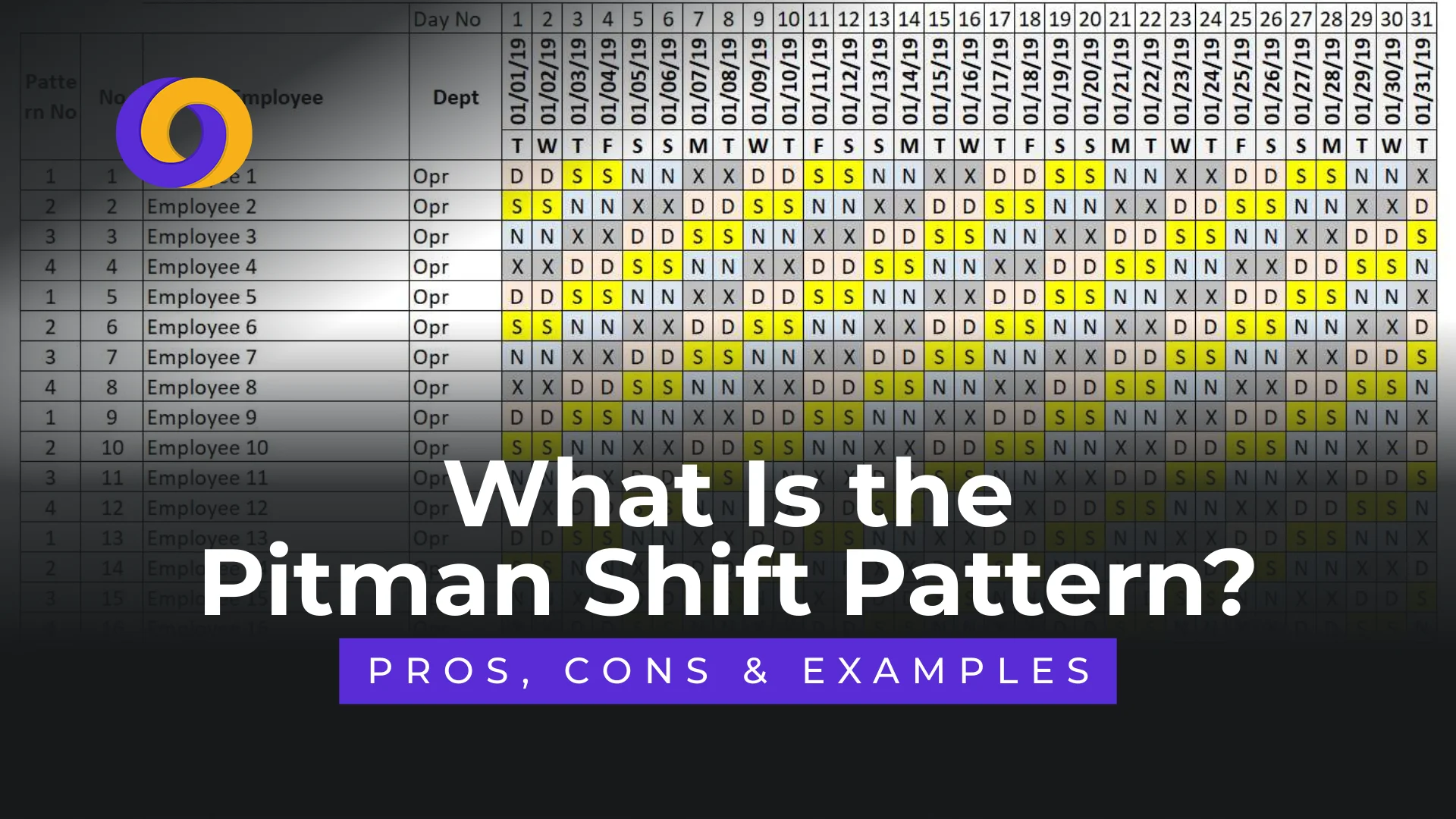
Fundamentally, the Pitman Shift Pattern is a two-week cycle with 12-hour shifts alternating between day and night blocks. Usually using four teams (crews) to guarantee 24/7 coverage, each team adheres to a standard shift schedule. It commonly follows a 2-2-3 (or 2-3-2) pattern: 2 days on, 2 nights on, 3 days off, 2 days on, 3 nights on, and 2 days off.
Let’s break down a standard two-week (14-day) cycle for one team:
Week 1:
- Day 1 & 2: Day Shift (e.g., 07:00 – 19:00)
- Day 3 & 4: Night Shift (e.g., 19:00 – 07:00)
- Day 5, 6, & 7: OFF
Week 2:
- Day 8 & 9: Day Shift
- Day 10 & 11: Night Shift
- Day 12, 13, & 14: OFF
The cycle then repeats. The magic is in the four-team arrangement (sometimes known as Teams A, B, C, and D). One team is on its 3-day break; the other three cover the round-the-clock schedule. Thus, assuring no operational gaps.
When to Use the Pitman Shift Pattern
The Pitman pattern is not one-size-fits-all. It is helpful in specific operational settings like:
- Healthcare (nursing, emergency rooms): The timetable reduces patient transfers (only twice per day), which is essential for ongoing care. The prolonged three-day breaks enable personnel to recover from the severe physical and mental requirements of 12-hour shifts.
- Process and Manufacturing Industries: Consistent coverage and lowered shift-change downtime assist plants unable to turn off without great cost. Better project continuity is possible on longer shifts thanks to the patterns.
- Public Safety & Emergency Services: Fire stations, ambulance services, and dispatch centres use it to guarantee complete crew readiness for extended times with plenty of built-in recovery time.
- Utilities & Critical Infrastructure: For power plants or water treatment plants needing ongoing monitoring, the Pitman schedule guarantees experienced teams are on duty for long durations.
Roles needing thorough daily cognitive analysis or ongoing client contact during business hours—such as most office-based finance or consulting positions—are less well suited for it.
The Pros: Why Organisations Adopt the Pitman Pattern
- Longer Time Off: The most important selling feature for staff members. The reoccurring 3-day weekends (or 3-day breaks) offer a great deal of time for relaxation, travel, and personal hobbies, hence enhancing perceived work-life balance considerably.
- Fewer Handovers: With only two shift changes each day—against three in an eight-hour system—there is less chance for communication errors. In areas like medicine, this equates to fewer clinical handoffs. Hence, lowering the likelihood of errors.
- Increased Continuity: Working 12 hours lets people see projects, jobs, or patient care through to a more natural finish, maybe raising efficiency and job satisfaction.
- Streamlined Scheduling and Coverage: The pattern is exceedingly predictable and simple for managers to model. Mathematically efficient, covering 168 hours a week with four teams usually necessitates fewer total personnel than some 8-hour revolving schemes.
- Longer Intervals Between Night Shift Blocks: Pairing night shifts, the schedule next provides for a lengthy break. Patterns that spread single night shifts—which might be more unsettling to the body’s circadian rhythm—are sometimes favoured.
The Cons: The Challenges and Risks
- Fatigue and Burnout Risk: Particularly in physically or psychologically difficult professions, a 12-hour shift is extensive. During the last hours, weariness can strike and maybe affect safety, alertness, and mistake rates. One must carefully control this risk.
- Social and Family Interruptions: Although the 3-day breaks are great, the rotating day/night schedule might be annoying. Employees who work on a typical diurnal cycle might miss daily weekday or weekend social/family events.
- Limited Flexibility for Appointments: For anything else, a 12-hour workday basically writes off that day. Managing home chores or making doctor’s appointments can prove more difficult than an 8-hour shift.
- Potential Health Effects: For some people, rotating between days and nights continuously, even with extended breaks, can strain the circadian rhythm, which, if not properly controlled, might cause metabolic changes or protracted sleep problems.
- Coverage Gaps During Breaks: Should many employees on the same team seek leave during their 3-day vacation period, it creates a 3-day coverage gap that can be more difficult to cover than a single day’s absence in an 8-hour system.
Real-World Examples
Example 1: Hospital Nursing Unit
- Team A: Works Days Mon-Tue, Nights Wed-Thu, off Fri-Sun. The following week, works Days Mon-Tue, Nights Wed-Thu, off Fri-Sun.
- Coverage: This ensures the ward always has a dedicated team for 12-hour periods, with nurses caring for the same patients for a full day or night cycle, improving care consistency.
Example 2: Chemical Plant Control Room
- Shift Sequence: The classic 2-2-3 pattern ensures a qualified operator is always monitoring the control systems. The long shifts allow them to oversee complete production batches, and the 3-day break provides decompression time from a high-pressure environment.
Final Thoughts
Though it is a double-edged sword, the Pitman Shift Pattern is a vital instrument if we talk of workforce management. Context and deliberate application determine all its success. In the appropriate environment—one where activities are suited to longer shifts and the employees value greater blocks of free time over daily routine—it can be a great recipe for employee happiness and operational consistency.
Still, it calls for respect for the extremely real dangers of exhaustion. Success demands strong health and safety measures, honest staff communication, and an openness to change. For sectors where its form fits operational requirements, it remains one of the most balanced and well-liked rotating schedules, deftly negotiating the difficult compromise of coverage, cost, and human well-being.
Implementing and controlling sophisticated shift arrangements like the Pitman schedule needs accuracy and adaptability. The sophisticated scheduling feature of Smart Workforce lets you simply create, visualize, and automate rotating schedules. Thus, guaranteeing adherence to working time laws and providing your team with clarity and control over their time.
Book a free demo to help you to simplify your shift scheduling using Smart Workforce.
Frequently Asked Questions
How many hours do you work in a Pitman schedule over two weeks?
In a 14-day cycle, your four 12-hour day shifts and four 12-hour night shifts follow the usual 2-2-3 configuration. Spread across two weeks, this amounts to 96 hours total or an average of 48 hours each week.
Does the Pitman schedule include weekends?
Yes, inherently. Employees will work weekends as part of the revolving cycle since it offers 24/7 coverage. Although the pattern does not particularly give weekends off top importance, the three-day breaks will usually include weekend days, providing a good balance over time.
Can the Pitman pattern be adapted?
Certainly. Although the 2-2-3 is traditional, adaptations abound to fit various purposes. The Pitman with a twist, such as 2 days, 3 nights, 2 off, 2 days, 2 nights, and 3 offs, changes the rhythm.

0 Comments