
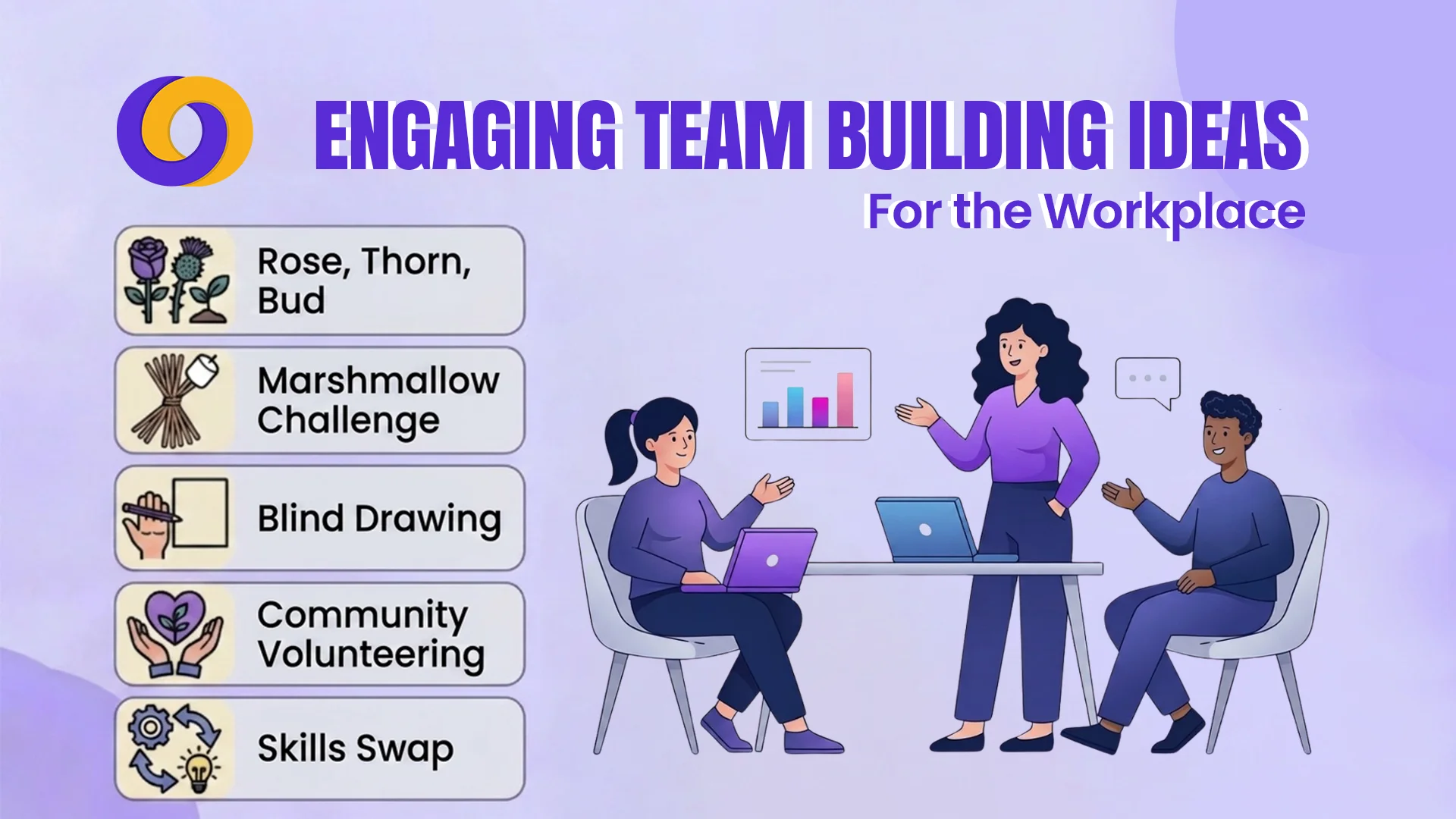
What are the Best Team Building Ideas for Work in 2026?
The best team development ideas in 2026 are short, engaging, and purpose-driven activities that improve communication, trust, and collaboration. Top options include quick daily check-ins, problem-solving challenges, escape rooms, and hybrid-friendly virtual activities.
They work best when they are:
- Voluntary (not forced)
- Relevant to real work challenges
- Designed for both in-person and remote teams
Let’s be honest. The phrase “team building” probably just made you wince.
You’re picturing it now: awkward trust falls, forced icebreakers where no one wants to share their “fun fact,” and that one colleague who takes the whole thing far too seriously. For years, staff collaboration has had a reputation problem. It’s been corporate theatre—activities everyone endures, but no one enjoys.
But here’s the thing: genuine employee bonding works. When done right, it builds psychological safety, breaks down silos, improves communication, and makes people want to come to work. According to Gallup, teams with high engagement show 21% greater profitability. Harvard Business Review studies show that well-structured activities can improve performance by up to 30%.
The problem isn’t staff collaboration. The issue is boring, irrelevant, one-size-fits-all workplace-culture activities.
This guide offers 25 fresh, engaging team-building ideas for the workplace in 2026. They’re organised by time commitment, cost, and team type—so you can find activities that work for your budget, your schedule, and your people.
Staff Collaboration Ideas by Category
Category | Best For | Time | Cost |
5-Minute Warm-Ups | Daily stand-ups, meeting openers | 5-10 mins | Free |
30-Minute Activities | Lunch breaks, Friday afternoons | 20-45 mins | Free-Low |
Half-Day Events | Off-sites, training days | 2-4 hours | Low-Medium |
Full-Day Experiences | Annual retreats, team rewards | 4-8 hours | Medium-High |
Remote & Hybrid | Distributed teams | Varies | Free-Low |
5-Minute Team Building Warm-Ups (Daily/Weekly)
These quick employee bonding games for work are perfect for starting meetings, shifting energy, or reconnecting after a stressful period. No materials needed, no awkwardness required. Each activity includes step-by-step instructions and tips for facilitation.
1. Rose, Thorn, Bud
How it works: Go around the room (or virtual circle) and ask each person to share three things: a rose—something positive that happened recently, a win, or a moment of pride; a thorn—a challenge, frustration, or something they’re struggling with; and a bud—something they’re looking forward to, an opportunity on the horizon, or a goal for the coming days.
Why it works: This format normalises sharing both successes AND struggles, which builds psychological safety. When people hear colleagues admit challenges, it becomes okay to be human. The “bud” adds forward momentum, preventing the exercise from becoming a complaint session.
Facilitation tip: Model vulnerability first. Share a genuine thorn, not a minor inconvenience. If the leader plays it safe, everyone else will too. Keep a timer—60 seconds per person max. For larger teams, split into breakout groups of 4-5 people.
Time: 5-10 minutes | Cost: Free
2. Two Truths and a Lie (Speed Round)
How it works: Each person shares three statements about themselves—two that are true, one that is false. The rest of the team guesses which is the lie. In the speed round, set a 10-second limit for guessing per person. Move quickly. No overthinking allowed.
Why it works: These classic workplace activities reveal surprising things about colleagues you thought you knew. The speed round keeps energy high and prevents the awkward silence that can happen when people deliberate too long. It’s low-stakes, fun, and builds personal connection without forced vulnerability.
Facilitation tip: Prohibit boring lies like “I don’t like coffee.” Encourage specific, interesting truths. If someone struggles, let them pass or offer to share a “fun fact” instead. For remote teams, use the chat function for guessing—it’s faster and includes everyone.
Time: 5 minutes | Cost: Free
3. The Check-In Pulse
How it works: Instead of the usual “how are you?” (which almost always gets the automatic reply “fine, thanks”), ask a specific, answerable question. Examples: “What’s one word for your energy level right now?” “What’s distracting you most today?” “On a scale of 1-10, how ready for this meeting are you?” “What do you need from this session to feel successful?”
Why it works: Vague questions get vague answers. Specific questions surface real information. This activity that builds teamwork identifies blockers before they become problems—a team member exhausted from a sleepless night, someone distracted by a personal crisis, or a group collectively overwhelmed by a project deadline.
Facilitation tip: Never judge the answer. If someone says “3” for energy, don’t say “cheer up!” That kills honesty immediately. Instead, ask “what would help?” or simply note it and adjust expectations. For remote teams, use a shared whiteboard or poll for anonymous responses.
Time: 3 minutes | Cost: Free
4. Appreciation Circle
How it works: One person starts by genuinely thanking or appreciating a specific person in the room. “I want to thank Sarah for staying late yesterday to help me finish the report.” That person then thanks someone else. Continue until every person in the room has been appreciated at least once.
Why it works: In most workplaces, appreciation is rare and generic (“great job, team”). This forces specificity and public recognition. It builds genuine connection in under five minutes. People feel seen. And people who feel seen stay.
Facilitation tip: “Good job” is not enough. Insist on specific behaviours: “Thank you for…” or “I appreciate how you…” For larger teams (10+), run this in smaller breakout groups. Keep a list to ensure no one is missed—being the only person not thanked is brutal.
Time: 5 minutes | Cost: Free
5. Would You Rather (Work Edition)
How it works: Pose a light-hearted “would you rather” question related to work. Examples: “Would you rather have no meetings for a month or a four-day workweek?” “Would you rather work from home forever or never again?” “Would you rather have a personal assistant or an unlimited training budget?” Each person answers briefly, explaining their choice.
Why it works: These questions are low-stakes enough to be fun but revealing enough to spark conversation. You learn what colleagues value—autonomy, flexibility, structure, and recognition. It gets people talking and laughing before diving into serious work.
Facilitation tip: Keep questions work-adjacent, not deeply personal. Avoid topics that could trigger disagreement (politics, religion). The goal is levity, not debate. For remote teams, use an emoji reaction poll before asking people to explain their choices.
Time: 5 minutes | Cost: Free
6. The Emoji Check-Out
How it works: At the end of a meeting, ask everyone to share one emoji that captures how they’re feeling. Use the chat function (virtual) or go around the room verbally (in person). No explanations required—just the emoji. Examples: 😊 for happy, 😩 for exhausted, 🤔 for confused, 🎉 for excited.
Why it works: Quick, visual, and completely optional. People can participate without explaining themselves. It gives the meeting leader an immediate read on team sentiment. Patterns emerge—if six people post the exhausted emoji, that’s data worth acting on.
Facilitation tip: Never demand an explanation. The power is in the pattern, not the individual. If someone consistently posts 😩, check in privately. For in-person meetings, keep printed emoji cards or use a whiteboard where people add stickers.
Time: 2 minutes | Cost: Free
30-Minute Workplace Culture Activities (Lunch & Learn / Friday Afternoon)
These ideas for the workplace fit into a lunch break or a Friday afternoon. Low commitment, high return. Each includes material lists and debrief questions.
7. Marshmallow Challenge
How it works: Divide into teams of 3-5 people. Provide each team with 20 sticks of uncooked spaghetti, one yard of tape, one yard of string, and one marshmallow. Give them exactly 18 minutes to build the tallest freestanding structure they can—with the marshmallow on top. The marshmallow must be whole and cannot be pierced or modified. Measure from the table to the top of the marshmallow.
Why it works: This classic game is used by architects, engineers, and business schools worldwide. It teaches rapid prototyping, iteration, and collaboration under pressure. Most teams spend too long planning and run out of time. The winning teams build quickly, test constantly, and adapt when things fail.
Debrief questions: What did your team do well? Where did you struggle? How many times did your tower fall? What would you do differently with another 18 minutes? (The answer: test earlier, build smaller, put the marshmallow on sooner.)
Materials needed: Per team: 20 spaghetti sticks, 1 yard tape, 1 yard string, 1 marshmallow. Tape measure for judging.
Time: 30 minutes (18 min build + 12 min debrief) | Cost: £10-15 for materials
8. The Problem-Solving Relay
How it works: Present a realistic work problem—not a hypothetical one. Examples: “A key client has moved their deadline forward by two weeks. What do we do?” “Our main supplier just went into administration. How do we maintain operations?” “The budget for next quarter has been cut by 20%—where do we reduce?”
Teams have 10 minutes to brainstorm solutions. No judgment. No “that won’t work.” Just ideas. Then each team has 2 minutes to present their best solution. The team with the most actionable, creative idea wins bragging rights.
Why it works: This isn’t a simulation—it’s a rehearsal. Teams practice solving problems they might face. The time pressure forces prioritisation. The competition creates energy. And the best ideas can be implemented after the session.
Facilitation tip: The problem must be realistic. If it’s too abstract, teams disengage. Have a leader present who can say “we’ll actually consider the winning idea” (and mean it). For remote teams, use breakout rooms and a shared whiteboard for brainstorming.
Time: 30 minutes | Cost: Free
9. Silent Sorting
How it works: The entire team must line up in order of birthday—month and day—without speaking. No sounds. No mouthing words. No writing notes. Gestures and hand signals only. Once the line is formed, everyone calls out their birthday to check accuracy.
Why it works: This is much harder than it sounds. People naturally want to talk. This activity that builds teamwork forces non-verbal communication, observation, and patience. It highlights who takes charge, who follows, and how the team solves problems without their most reliable tool: words.
Facilitation tip: For large groups (20+), run this in smaller teams of 6-8 people. The confusion is part of the learning. Afterward, debrief: “Who emerged as leaders? How did you communicate? What frustrated you?” For remote teams, use a shared spreadsheet with birthdays hidden—then reveal after sorting.
Time: 15-20 minutes | Cost: Free
10. Identity Blind Drawing
How it works: One team member (the “describer”) is shown an image that the rest of the team cannot see. The describer must describe the image in words only—no hand gestures, no “it looks like a…” comparisons. The rest of the team draws based solely on the description. After 5-8 minutes, compare the drawings to the original image.
Why it works: The results are almost always hilarious and humbling. The describer thinks they’re being perfectly clear. The drawers are utterly confused. This exercise highlights how easily instructions get misinterpreted and why assumptions are dangerous.
Good images to use: Abstract shapes, geometric patterns, simple cartoons (avoid anything recognisable like “a cat”—that’s too easy). The more ambiguous, the better the debrief.
Facilitation tip: Let multiple people take a turn as describers. Debrief questions: “What would have helped?” (Answer: two-way questions, confirmation loops, simpler language). For remote teams, use Zoom’s whiteboard or Google Jamboard for drawing.
Time: 20 minutes | Cost: Paper and pens (or digital whiteboard)
11. The Feedback Exchange
How it works: Before the session, ask each team member to write down (anonymously) one specific thing they appreciate about every other team member. If that’s too many, focus on the 2-3 people they work with most closely. Collect all responses, collate them by recipient (remove any identifying details), and share each person’s compiled feedback with them privately.
Why it works: Most people receive almost no specific, positive feedback at work. “Good job” is generic. “The way you handled that client complaint last week was brilliant—your patience under pressure is a real strength” is specific, actionable, and memorable. This is powerful for remote teams who rarely receive informal praise.
Facilitation tip: Do this offline before the session. The compilation takes time. Never skip the anonymity—fear of recognition changes what people write. If using digital tools, Slido, Mentimeter, or Google Forms work well.
Time: 30 minutes prep, ongoing distribution | Cost: Free
12. Scavenger Hunt (Office or Online)
How it works: Office version: Hide 10-15 small items around the office before the session. Give teams a list and a time limit (10-15 minutes). First team to find all items wins. Remote version: Ask participants to find specific objects in their homes within 5 minutes. Examples: “something blue, something that makes noise, something you’ve owned for over 10 years, something that represents your weekend.” First person back to the camera with all items wins.
Why it works: It’s ridiculous. That’s precisely why it works. People laugh. They run around. They compete. Stress melts. For remote teams, it’s a rare chance to see colleagues’ home lives without forced “getting to know you” sessions.
Facilitation tip: The prizes should be silly—a chocolate bar, a trophy printed on office paper, first choice of lunch spot next week. Serious prizes create serious competition, which misses the point. For online, emphasise creativity over speed.
Time: 15 minutes | Cost: Free (unless you buy prizes)
13. Mission Impossible (Process Improvement)
How it works: Identify a real internal process that everyone agrees is unnecessarily complicated. Examples: expense reporting, leave requests, IT support tickets, client onboarding. Teams have 30 minutes to brainstorm how to simplify it. No approval needed during brainstorming—any idea is allowed. After 30 minutes, teams present their best idea. Leadership commits to implementing the winning idea by the next quarter.
Why it works: Most process improvement happens in closed meetings with managers. This democratises it. People closest to the work know what’s broken. This session gives them permission to fix it—and the commitment to actually implement the winning idea ensures follow-through.
Facilitation tip: The leadership commitment is non-negotiable. If you won’t implement the winning idea, don’t run this exercise. It will destroy trust. For remote teams, use a shared whiteboard or Trello board to capture ideas in real time.
Time: 30 minutes | Cost: Free
14. The Yes, And… Circle
How it works: One person starts a story with a single sentence. “I walked into the office and saw a penguin standing by the coffee machine.” The next person adds a sentence, but they must start with “Yes, and…” No “buts,” no contradictions, no redirecting. “Yes, and the penguin was wearing a name tag that said ‘Gerald.'” Continue around the circle until the story reaches a natural (or hilarious) end.
Why it works: Improvisation is the ultimate employee bonding activity. “Yes, and” builds on ideas instead of blocking them. “Yes, but” shuts down creativity. This game reveals which team members naturally build on others’ ideas—and which tend to redirect or negate. It builds psychological safety and collaborative thinking.
Facilitation tip: If someone says “yes, but,” gently correct them. “Try that again, starting with ‘yes, and.'” The first few rounds will be awkward. That’s fine. By the end, people will be laughing. For remote teams, use a shared document where each person types their sentence in turn.
Time: 15 minutes | Cost: Free
Half-Day Team Collaboration Events (Off-Sites & Training Days)
For when you have more time and want a deeper connection. These fun team-building ideas for the workplace get people out of their usual environment and routines. Each includes a preparation checklist and debrief framework.
15. Escape Room (Physical or Virtual)
How it works: Book a local escape room venue for in-person teams or use a virtual escape room platform for distributed teams. Teams work together to solve puzzles, find clues, and “escape” within a set time limit (typically 60 minutes). Success requires communication, delegation, diverse thinking, and calm under pressure.
Why it works: Escape rooms are designed for teamwork. You can’t solve it alone. Different puzzles require different skills—someone good at patterns, someone good at spatial reasoning, someone good at organisation. It reveals natural strengths without any “assessment” feeling like assessment.
Facilitation tip: The debrief matters more than the game. Afterward, ask: “Who took the lead? How did you handle frustration? What did you learn about how your team solves problems?” Book venues that allow team photos afterward—it’s a tangible memory. For virtual, use platforms like The Escape Game or Escape Room Live.
Time: 60-90 minutes (plus travel and debrief) | Cost: £20-40 per person
16. Cooking Challenge
How it works: Teams receive identical mystery ingredients (e.g., chicken breast, random vegetables, a few spices, a strange grain like quinoa or couscous). No recipes allowed. No phones. They have 90-120 minutes to create a dish together, naming it and plating it for presentation. Judging criteria include creativity, presentation, taste, and teamwork.
Why it works: Cooking together is inherently collaborative. It requires planning (who chops, who stirs, who watches the timer), negotiation (how spicy should it be?), and creativity (what even is this ingredient?). The shared meal afterward is the reward.
Facilitation tip: Hire a chef or use a cooking school kitchen—kitchen safety matters. Accommodate dietary restrictions beforehand. Have backup ingredients for disasters (and there will be disasters). The judges should be neutral (senior leaders not on any team, or external guests). For virtual teams, send identical ingredient kits in advance and cook together over video.
Time: 2-3 hours | Cost: £15-25 per person (plus venue if needed)
17. Community Volunteering
How it works: Arrange a half-day volunteer session with a local charity—food bank sorting, care home visiting, park clean-up, community garden planting, school supplies packing, or shelter meal preparation. Teams work side-by-side on meaningful work that has nothing to do with their day jobs.
Why it works: This builds connection through shared purpose outside work. The hierarchy flattens—the CEO and the intern both pack food boxes. People see colleagues in a different light (more patient, more compassionate, more human). Plus, it’s genuinely meaningful work that benefits the community.
Facilitation tip: Let employees choose the charity. Mandatory volunteering isn’t volunteering. Ensure the activity is accessible (no mobility-heavy tasks for office workers who haven’t exercised in years). Brief the charity beforehand on your team size and any needs. Afterward, debrief: “What surprised you? How did it feel to work together outside the office?”
Time: 3-4 hours (plus travel) | Cost: Free (donations optional, but encouraged)
18. The Decision-Making Simulation
How it works: Create a realistic business scenario that your team might face. Examples: “Our main supplier has gone bankrupt—what do we do in the next 48 hours?” “A key client has threatened to leave unless we reduce costs by 20% this month.” “A competitor just released a product that makes ours obsolete—how do we respond?”
Teams compete to produce the best action plan in 90 minutes. At the end, each team presents to a panel of leaders for 5 minutes. The winning team’s plan is considered for implementation (or is used as a starting point for real strategy).
Why it works: This isn’t a simulation—it’s a rehearsal. Teams practise making decisions under pressure, with incomplete information, and with consequences (the competition aspect). It builds strategic thinking, collaboration, and confidence. And it produces ideas you can use.
Facilitation tip: The scenario must be realistic and relevant. If it’s too abstract, teams disengage. The judging panel should include at least one decision-maker who can genuinely say “we’ll consider this.” Score teams on creativity, feasibility, and presentation clarity. For remote teams, use breakout rooms and a shared timeline.
Time: 2-3 hours | Cost: Free
19. Outdoor Navigation Challenge
How it works: Give teams a map (not a phone), a compass, and a set of coordinates. The first team to navigate to all checkpoints wins. Use a local park, nature reserve, or even a large university campus if you don’t have wilderness access. Set 5-8 checkpoints of varying difficulty.
Why it works: This works brilliantly for office workers who spend their days at desks. It gets people moving, outdoors, and problem-solving together. Navigation under mild stress (we’re lost! do we go left or right?) reveals natural leaders, followers, and how teams handle pressure.
Facilitation tip: Prioritise safety. Checkpoints should be on paths, not off-trail. Have a sweeper team following the last group. Brief everyone on “What if you’re truly lost?” protocols. For urban settings, use landmarks (the third bench and the blue door) instead of coordinates. Have a debrief picnic afterward.
Time: 2-3 hours | Cost: Free (public land) or minimal (map printing)
20. Skills Swap
How it works: Each team member teaches one skill they have in 15-20 minutes. The skill can be work-related (spreadsheet shortcuts, presentation design, conflict resolution) or personal (bread baking, basic car maintenance, beginner yoga, photography composition). No PowerPoints allowed. Hands-on teaching only.
Why it works: Everyone has a skill someone else lacks. This session surfaces hidden talents, makes people feel valued, and builds cross-functional knowledge. The personal skills create connection that work skills alone can’t achieve.
Facilitation tip: Ask for volunteers in advance—not everyone is comfortable teaching. Schedule 15-minute slots with 5-minute breaks. Provide any materials needed (someone teaching yoga needs a mat; someone teaching spreadsheet shortcuts needs screen share). Rotate so each person teaches at most once. Use the final hour to reflect: “What did you learn? Who’s a secret expert you didn’t know about?”
Time: 2-3 hours (depending on team size) | Cost: Free (materials as needed)
Full-Day Team Engagement Experiences (Annual Retreats)
For the big investment. These team bonding games for work (at scale) create lasting memories and genuine culture shifts.
21. Off-Site Hackathon (Not Just for Tech)
How it works: Teams spend a full day solving a real business problem—not a hypothetical one. Define the problem in advance (e.g., “How do we reduce time-to-hire by 50%?” or “How do we improve client retention?”). Teams work from 9am-4pm, with scheduled check-ins and “office hours” with experts. At 4pm, teams present solutions to leadership. Leadership commits to implementing the winning idea within 90 days.
Why it works: This is the activity that delivers actual ROI. The output is a real solution to a real problem. The spirit is collaborative, not competitive (though competition adds energy). The implementation commitment ensures follow-through.
Facilitation tip: The problem must be scoped correctly—too broad (how do we solve world hunger?) and nothing actionable emerges. Too narrow (how do we reorganise the supply closet?) and it’s not worth a full day. The leadership commitment is non-negotiable. Provide food throughout—hungry brains don’t innovate.
Time: 1 full day | Cost: Venue + catering (plus potential facilitator)
22. The Co-Creation Day
How it works: Instead of leadership dictating the next quarter’s strategy, spend a full day with the entire team designing priorities together. Morning session: data review and trends (what’s working, what’s not). Afternoon session: breakout groups generate and prioritise initiatives. Final hour: whole-group voting on the top 3-5 priorities for the quarter.
Why it works: Strategy created by a small leadership team and “cascaded” down is rarely owned by frontline staff. Co-created strategy is understood, agreed with, and acted upon. This builds ownership, alignment, and trust all at once.
Facilitation tip: Bring an external facilitator if internal politics are heavy. The data review must be objective—no cherry-picking facts to support predetermined conclusions. The voting process must be transparent. Document the agreed priorities and hold leadership accountable to them.
Time: 1 full day | Cost: Facilitator fee if external, otherwise free
23. Wellness Retreat Day
How it works: A full day with no agenda, no deliverables, no expectations. Optional gentle movement (yoga, walking, stretching). Guided reflection (journaling, group sharing, mindfulness exercises). Good food (slow, communal meals). Unstructured social time (walks, games, conversation). No phones.
Why it works: Sometimes the best collaboration is doing nothing together. This acknowledges that people are exhausted, that work is intense, and that rest is a prerequisite for high performance. It builds connection through shared calm, not shared activity.
Facilitation tip: Everything must be optional. Someone who wants to sleep in, skip yoga, and just read a book in the corner is still participating. That’s rest. Book a venue with outdoor space. Hire facilitators who understand trauma-informed practice (no forced sharing). The single rule: no work talk.
Time: 1 full day | Cost: Venue + facilitator + catering
24. Cross-Training Immersion
How it works: Each team member spends half a day (or a full day) shadowing someone in a completely different role. The graphic designer shadows the warehouse picker. The accountant shadows the customer support team. The salesperson shadows the production line. Afterwards, everyone debriefs together: what surprised you? what was harder/easier than you expected? what would you change about how your role interacts with theirs?
Why it works: Most conflicts between departments come from ignorance—people don’t understand what colleagues do. This builds empathy across functions. It surfaces process improvements from people who see the whole picture. And it breaks down the “us vs them” silos that kill collaboration.
Facilitation tip: Plan the shadowing in advance—not everyone’s role can accommodate a shadow without impacting work. Set clear boundaries: no judgment, no “well, you should…” feedback during the shadowing. Debrief in small groups first, then share themes with everyone. The output should be action items for improving cross-functional collaboration.
Time: 1 full day | Cost: Free (lost productivity but high return)
25. The Legacy Project
How it works: Teams spend a full day designing and delivering something that will outlast them. Options include: documenting a critical process that only one person knows, creating a training video series for future hires, building a resource library for new team members, or developing a “lessons learned” repository from past projects. At the end of the day, teams present their deliverables. Leadership commits to maintaining and using the created assets.
Why it works: Most work is ephemeral—emails sent, meetings held, forgotten by next week. This creates meaning and purpose. People work harder when they know their work matters beyond the current quarter. It’s team bonding with lasting value.
Facilitation tip: The deliverable must be genuinely useful. No “We’ll put it on the server somewhere.” Identify needs in advance—ask the team what they wish existed when they joined. The best legacy projects fill real gaps. Schedule quarterly follow-ups to ensure the assets are being used and maintained.
Time: 1 full day (plus follow-up) | Cost: Free
Remote & Hybrid Team Collaboration: Special Considerations
Staff bonding and hybrid work don’t always mix well. Here’s how to adapt.
Challenge | Solution |
Zoom fatigue | Keep activities under 30 minutes. Use breakout rooms. Enable cameras but don’t demand them. |
Asynchronous teams | Run “weekly photo challenges” (e.g., “best coffee setup,” “weirdest thing within 3 feet of your desk”). |
Time zone differences | Record activities for those who can’t attend live. Run regular but rotating times so no one always misses out. |
Lack of informal connection | Create non-work Slack channels (#pets, #gardens, #whats-for-dinner). Schedule optional “coffee roulette” random pairings. |
Remote-specific activities that work well:
- Virtual coffee roulette – Randomly pair colleagues for a 15-minute non-work chat, with a small budget for coffee. (Free – £5 per person)
- Online board games – Platforms like Board Game Arena or Jackbox Games are surprisingly effective for distributed teams. (Free – £5 per person)
- The Great Remote Bake-Off – Everyone bakes the same recipe (or their favourite) on a video call, then shares results. Delicious and low stakes. (Cost: Ingredients)
Employee Development on a Budget: Low-Cost, High-Impact Ideas
Not every organisation has a budget for escape rooms and off-sites. These teamwork activities cost almost nothing but still deliver.
Activity | Cost | Why It Works |
Walking meetings | Free | Movement reduces defensiveness. Conversations flow more naturally side-by-side than face-to-face. |
Lunch roulette | Cost of lunch | Randomly mix teams for lunch once a month. Simple. Effective. |
The “Kudos Board” | Free | A Slack channel or physical board where anyone can publicly thank anyone else. |
Show and Tell | Free | Each person brings an object meaningful to them and shares why. |
Paper plane competition | £5 for paper | Builds collaboration, creativity, and healthy competition. Plus, it’s fun. |
Measuring the ROI of Morale Boosting
How do you know if your group cohesion ideas for workplace are working? Track these metrics before and after:
Metric | Source |
Employee engagement score | Anonymous pulse surveys |
Team collaboration quality | 360-degree feedback, project post-mortems |
Psychological safety | Surveys using Google’s Project Aristotle framework |
Retention rate | HR data—are people staying or leaving? |
Meeting effectiveness | “Did this meeting need to happen?” survey |
If you’re not measuring, you’re guessing. And guessing is expensive.
Common Collaboration Mistakes to Avoid
After 25 ideas, here’s what NOT to do:
Mistake | Why It’s a Problem |
Making it mandatory | Forced fun isn’t fun. Offer opt-outs. |
Ignoring introverts | Not everyone enjoys improv or public speaking. Offer quieter options. |
One-size-fits-all | Remote, hybrid, and in-person teams need different approaches. |
No follow-through | An activity without action is just entertainment. Connect activities to real work. |
Cringey activities | Trust falls. Role-playing customer complaints. Reading each other’s “love languages.” Just don’t. |
Treating it as a one-off | It is a process, not an event. Build small, consistent habits, not annual off-sites. |
Expert Insight: Why Staff Bonding Matters More in 2026
Smart Workforce has the capability to observe that organisations investing in structured team engagement see measurable improvements in retention, communication, and productivity—especially in hybrid environments.
Modern collaboration is no longer about activities—it’s about:
- Psychological safety
- Real collaboration
- Performance alignment
Conclusion
The best team-building activity ideas for the workplace share three things: they’re voluntary, they’re relevant, and they’re enjoyable. They build psychological safety. They break down hierarchies. And they remind people that work is better together.
You don’t need a massive budget or a professional facilitator. You need intention, consistency, and a willingness to try things that might fail. Start small. One 5-minute check-in. One Friday afternoon scavenger hunt. One walking meeting.
Your team will thank you. And they might even stop rolling their eyes when they hear “team building”.
Build a Stronger, More Engaged Workforce
Team development works best when supported by the right systems.
Smart Workforce helps you:
- Optimize staff scheduling
- Improve team coordination
- Boost employee performance
Start building a more connected workplace today.
Frequently Asked Questions
What are low-cost team-building ideas for small businesses?
Low-cost collaboration ideas include walking meetings, appreciation circles, lunch roulette, and quick problem-solving games. These activities require little to no budget but significantly improve team morale and communication.
Why do team-building activities fail?
Employee bonding fails when it is forced, irrelevant, or disconnected from real work challenges. Employees disengage when activities feel artificial or mandatory.
What is the ROI of team building?
Effective staff development improves employee engagement, reduces turnover, and enhances collaboration. Studies show engaged teams can increase profitability by over 20%.
What is the most effective team-building activity for remote teams?
Virtual coffee roulette—randomly pairing colleagues for 15-minute non-work chats—is consistently rated as the most effective remote team-building activity. It builds informal connections that formal meetings can’t replicate. Keep it optional, keep it short, and provide a small budget for coffee.
How often should we do team-building activities?
Small activities weekly or bi-weekly (5-10 minute check-ins and appreciation circles) build consistent habits. Larger activities quarterly (half-day off-sites, volunteering) create deeper connections. Annual retreats are for celebration and reflection. Frequency matters less than consistency and relevance.
What if team members refuse to participate?
Don’t force it. Mandatory fun isn’t fun. Offer opt-outs with no consequences. Some people genuinely recharge alone. Respect that. Forcing participation damages psychological safety more than skipping the activity ever would.
How do I handle team building in a hybrid environment?
Run parallel activities—an in-person option and a virtual option simultaneously. Record sessions for asynchronous participation. Rotate the timing of live activities so the same people aren’t always excluded due to time zones. Most importantly, don’t let in-person teams plan activities that remote colleagues can’t join.
What’s a quick team-building activity for a 15-minute meeting?
Rose, Thorn, Bud (each person shares a win, a challenge, and something they’re looking forward to) takes 5-10 minutes and builds psychological safety quickly. The Appreciation Circle (thanking someone specific in the room) takes 5 minutes and shifts energy immediately. Both work for teams of any size.

0 Comments