
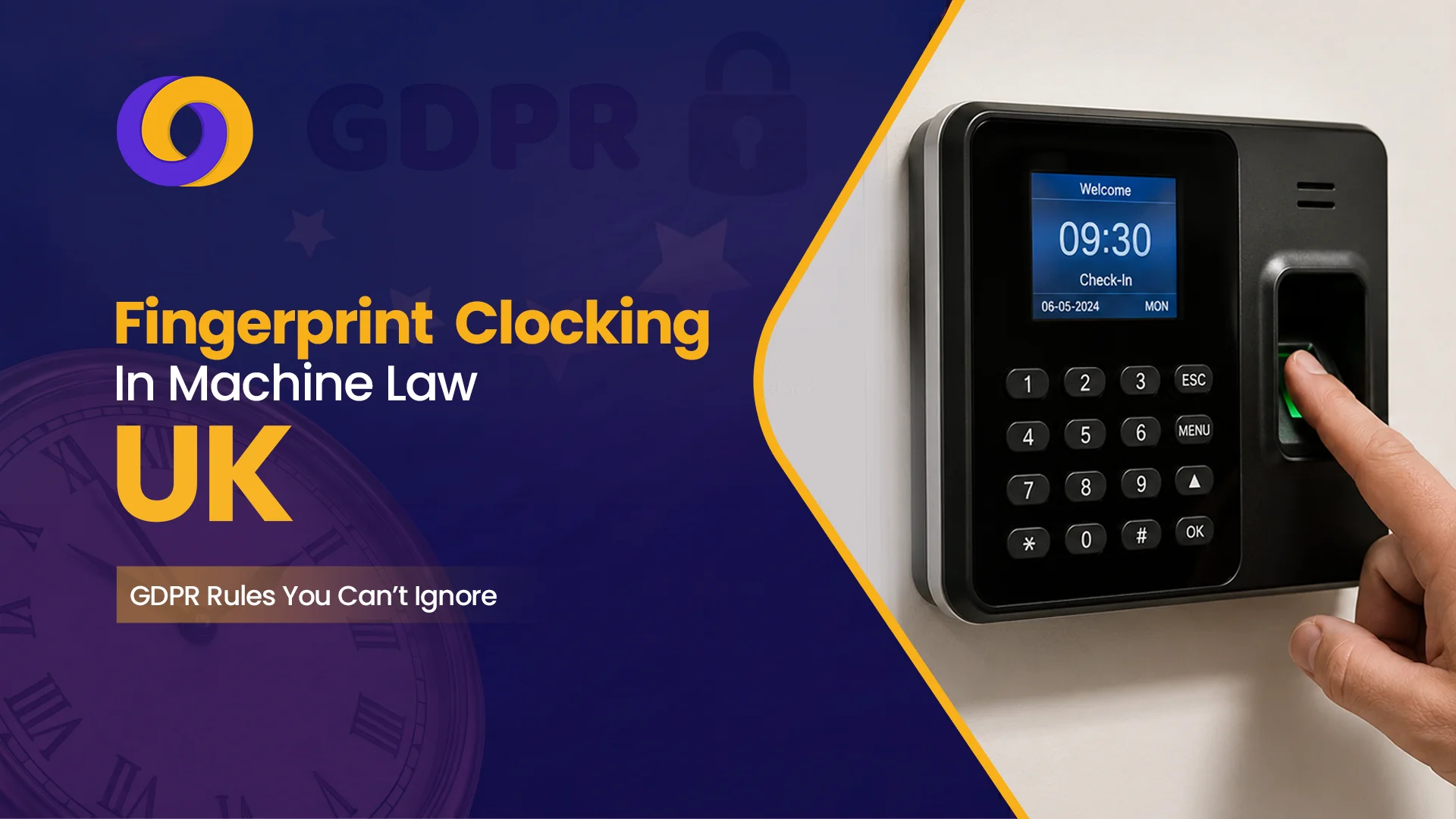
The pitch is tempting. A fingerprint clocking-in machine promises accuracy, convenience, and an end to “buddy punching.” No more forgotten swipe cards. No more PINs shared between colleagues. Just a quick scan, and attendance is logged.
But here’s what the sales brochure doesn’t tell you: in UK law, a fingerprint is not just a fingerprint. It’s “special category data” under the UK GDPR. That means it sits alongside health records, genetic data, and information about political opinions and religious beliefs — some of the most sensitive personal information you can process.
The fingerprint clocking law in the UK has become increasingly strict. The Information Commissioner’s Office (ICO) has issued enforcement notices against employers who implemented biometric systems without proper legal justification. And with the Data (Use and Access) Act 2025 now in force, the rules have only become more defined.
Ignorance is not a defence. If you use — or are considering — a fingerprint clocking system for employee attendance, you need to understand the legal framework before you scan a single finger.
What Does UK Law Say About Biometric Clocking In Systems?
Biometric Data Is Special Category Data
Under Article 9 of the UK GDPR, biometric data is defined as:
“Personal data resulting from specific technical processing relating to the physical, physiological or behavioural characteristics of a natural person, which allow or confirm the unique identification of that natural person, such as facial images or dactyloscopic [fingerprint] data”.
This matters because biometric data processed for the purpose of uniquely identifying a person is automatically classified as “special category data”. Special category data cannot be processed unless you meet both:
- A lawful basis under Article 6 of the UK GDPR
- A separate special category condition under Article 9
Fingerprint scanning for attendance tracking almost always involves unique identification. The system confirms that Sarah, not John, is clocking in. This means you are firmly in special category territory.
Is Fingerprint Clocking Legal in the UK?
Yes, fingerprint clocking is legal in the UK, but only if employers comply with UK GDPR by providing a lawful basis, an Article 9 condition, a DPIA, and a non-biometric alternative.
Pros and Cons of Fingerprint Clocking Systems
Let’s discuss the pros and cons of fingerprint clocking systems:
Pros
- High accuracy – Eliminates “buddy punching” (employees clocking in for absent colleagues) almost completely
- Fast and convenient – Scan takes less than a second; no cards or passwords to remember
- No lost or forgotten credentials – Employees always have their fingerprint with them
- Reduces administrative errors – Automated tracking eliminates manual timesheet mistakes
- Difficult to falsify – Unlike PIN codes or swipe cards, fingerprints cannot be easily shared or stolen
- Seamless integration – Works with payroll and HR systems for automated calculations
- Non-transferable – Ensures the correct person is clocking in every time
Cons
- High GDPR risk – Fingerprints are “special category data” under UK GDPR, requiring strict legal compliance
- Mandatory Data Protection Impact Assessment (DPIA) – Required before implementation; time-consuming and technical
- Must provide non-biometric alternative – Employees cannot be forced to use fingerprint; swipe card, PIN, or app alternative required with no detriment
- Serco case warning – ICO has publicly enforced against employers who implemented biometrics without proper justification
- Risk of ICO fines – Up to £17.5 million or 4% of global turnover for serious breaches
- Irreplaceable data – If a fingerprint template is stolen, the employee cannot get a new fingerprint
- Employee resistance – Some workers object on privacy grounds, leading to grievances or employment claims
- Ongoing compliance burden – Regular reviews, retention policies, and deletion protocols required
- Hardware costs – Scanners, installation, and maintenance add to expenses (£50-200 per device)
- Not suitable for all environments – Wet, dirty, or gloved hands can cause recognition failures
Pros vs Cons
Pros | Cons |
Eliminates buddy punching | High GDPR risk (special category data) |
Fast and convenient | Mandatory DPIA required |
No lost cards or forgotten PINs | Must provide non-biometric alternative |
Reduces payroll errors | ICO enforcement risk (Serco case) |
Difficult to falsify | Fines up to £17.5 million |
Integrates with payroll | Irreplaceable if data breached |
Ensures correct person | Employee privacy objections |
— | Ongoing compliance burden |
— | Hardware costs |
— | Recognition issues (wet/gloved hands) |
Bottom Line Recommendation
Fingerprint clocking can be lawful if you complete a DPIA, provide a genuine non-biometric alternative with no detriment, and document your legal basis carefully. However, for most UK employers, lower-risk alternatives (QR codes, mobile apps, swipe cards) achieve similar accuracy without the GDPR exposure. If you proceed with biometrics, consult legal advice first.
The Prohibition and the Exceptions
Article 9(1) of the UK GDPR states that processing special category data is prohibited — unless one of the exceptions in Article 9(2) applies.
For employers, the relevant exceptions typically include:
Article 9(2) Condition | When It Might Apply |
(a) Explicit consent | The employee freely gives specific, informed permission |
(b) Employment, social security and social protection law | Processing is necessary for carrying out obligations or exercising specific rights in employment law |
(g) Substantial public interest | Processing is necessary for reasons of substantial public interest, with a basis in UK law |
Most employers instinctively reach for consent. But as we’ll explore, consent is often the wrong choice in an employment context due to the inherent power imbalance between employer and employee.
Comparison Table: Fingerprint vs Alternatives
Method | GDPR Risk | Cost | Ease of Use |
Fingerprint Scanning | High – Biometric data is “special category” requiring lawful basis, Article 9 condition, DPIA, and non-biometric alternative. Risk of ICO enforcement if non-compliant (e.g., Serco case). | Medium-High – Hardware costs (£50-200 per device), installation, maintenance, plus potential legal/compliance costs. | Very Easy – Fast scan, no cards or passwords to remember. Employees simply press and go. |
Facial Recognition | High – Same as fingerprint; biometric “special category” data. Requires same compliance steps (DPIA, alternative method, etc.). Subject to same ICO scrutiny. | Medium-High – Camera hardware (£100-300) or tablet-based systems; software licensing fees. | Very Easy – Contactless, no physical touch. Employee glances at device and clocks in. |
Mobile App with GPS | Low-Medium – Not biometric. Requires consent for location tracking. Must be transparent about data collection and retention. GDPR risk lower than biometrics. | Low-Medium – Subscription per user (£2-5/month). No hardware costs. Existing smartphones used. | Easy – Employees clock in/out via app. GPS verification ensures location accuracy. Requires smartphone. |
QR Code Scanning | Low – No biometric data. Verifies presence only. Minimal personal data collected. Low GDPR risk if properly managed. | Low – Printed QR codes (negligible cost). Mobile app required for scanning. | Easy – Employee scans a static QR code at the workplace using a mobile app. Works offline. |
RFID/Swipe Card | Low – No biometric data. Card can be linked to employee ID; minimal personal data processing. Low GDPR risk. | Medium – Card readers (£50-150) plus replacement cards (£1-3 each). Ongoing cost for lost cards. | Easy – Tap card on reader. Cards can be lost, shared, or forgotten. |
PIN Code | Low – No biometric data. Minimal personal data; low GDPR risk. Buddy punching possible (codes shared). | Very Low – Keypad hardware (£30-100) or software-based. No ongoing card replacement costs. | Easy – Enter code. No equipment to carry. Risk of shared codes and forgotten PINs. |
Password/Login | Low – No biometric data. Low GDPR risk. Requires secure password storage. | Very Low – Software-only solution. No hardware costs. | Moderate – Requires remembering credentials. Slower than biometrics or tap cards. |
If you prioritise, here’s the recommended method
- Lowest legal risk – QR Code, RFID/Swipe Card, or PIN Code
- Lowest cost – PIN Code or Password/Login (software only)
- Ease of use + low risk – Mobile App with GPS or QR Code Scanning
- High security + compliant – RFID/Swipe Card (no biometric risk) OR Biometrics ONLY with full GDPR compliance (DPIA, alternative method, staff consent)
Key Takeaway: Fingerprint and facial recognition offer convenience but carry high GDPR risk and require significant legal compliance work. Non-biometric alternatives (QR codes, swipe cards, mobile apps) achieve similar results with much lower legal exposure — and should always be offered as an option to employees who opt out of biometric systems.
The Serco Case
Perhaps the most significant warning for UK employers comes from the ICO’s enforcement action against Serco in 2024/2025.
Serco implemented facial recognition and fingerprint scanning to monitor staff attendance without:
- Properly assessing privacy risks
- Demonstrating that biometrics were necessary
- Considering alternatives, such as ID cards or PIN codes
The ICO ordered Serco to:
- Stop using the technology immediately
- Delete most of the biometric data collected
- Comply within three months
This was not a quiet warning. It was a public enforcement action designed to send a message: biometric monitoring will face serious scrutiny.
If a large, well-resourced organisation like Serco can fall foul of the rules, so can any business. The lesson is clear: you cannot assume biometrics are lawful simply because they are convenient.
Do Fingerprint Clocks Violate GDPR? The Legal Test
The short answer is: ‘not automatically, but they very easily could if you don’t meet the legal requirements.
The ICO’s guidance sets out a clear framework for assessing whether a fingerprint clocking system is lawful.
Step 1: Is Biometric Data Necessary?
Before implementing any biometric system, you must ask: is this genuinely necessary? Many of the lawful bases depend on your use of biometric data being “necessary” — not merely useful, convenient, or standard practice.
Questions to ask yourself:
- What specific problem are you solving? (e.g., “buddy punching” costing £X per year)
- Could a less intrusive alternative work? (e.g., swipe cards, PIN codes, mobile app check-in)
- If an alternative is available, why is it inadequate?
If you cannot demonstrate that fingerprint scanning is proportionate and targeted, your legal basis collapses.
The ICO states: “It is not enough to argue that handling the personal information is necessary because you operate your business in a particular way. The question is whether the use of personal information is objectively necessary for your stated purpose”.
Step 2: Provide a Genuine Alternative
One of the most critical rules in biometric and fingerprint clocking law is this: if you use biometrics, you must offer employees a genuine, non-biometric alternative.
The ICO guidance is explicit: “If you are relying on biometric data for workspace access, you should provide an alternative for those who do not want to use biometric access controls, such as swipe cards or pin numbers. You should not disadvantage workers who choose to use an alternative method”.
Examples of acceptable alternatives:
- Swipe cards or key fobs
- PIN codes
- Mobile app-based check-in
- Proximity cards
Crucially, employees who opt out of the biometric system must face no detriment. No reduced pay. No different shift allocations. No negative performance reviews. Any disadvantage — real or perceived — undermines your legal position.
Step 3: Choose Your Lawful Basis and Special Category Condition Carefully
Once you have established necessity and provided an alternative, you must document your lawful basis and Article 9 condition.
Lawful Basis (Article 6) | Typical Use |
Legitimate interests | Often used where security or fraud prevention is the goal |
Contract | Where attendance tracking is explicitly tied to employment terms |
Special Category Condition (Article 9) | Typical Use |
Explicit consent | ONLY if a genuine, workable alternative exists and no detriment for refusal |
Employment law (Article 9(2)(b)) | Where processing is necessary for employment obligations and appropriate safeguards exist |
Consent is a trap. In an employment relationship, the power imbalance between employer and employee means consent is rarely “freely given”. The ICO has stated that it is “likely to be very hard to justify using biometric data for access control without providing an alternative”.
When consent might work: The ICO’s example shows that if you offer a swipe card alternative with no detriment, consent becomes viable. Employees can choose between biometrics (with consent) and the non-biometric method (without consent). This is the gold standard for lawful implementation.
Step 4: Complete a Data Protection Impact Assessment
Because processing biometric data is considered high risk, you are legally required to complete a Data Protection Impact Assessment (DPIA) before you start processing.
Your DPIA must document:
- Your purpose for collecting biometric data
- Why biometrics are necessary (not just convenient)
- What less intrusive alternatives did you consider and why they were rejected
- The risks to employees (e.g., data breach consequences)
- How you will mitigate those risks (encryption, access controls, retention limits)
- Whether you need to consult the ICO before proceeding
If your DPIA identifies a high risk you cannot adequately reduce, you must consult the ICO before implementing the system. Failure to do so is itself a breach.
Step 5: Implement Robust Security Measures
Biometric data cannot be replaced. If a password is stolen, you reset it. If a fingerprint template is stolen, the employee cannot get a new fingerprint. This makes security non-negotiable.
Minimum security requirements:
- Encrypt biometric templates at rest and in transit
- Store templates, not raw images or fingerprints, wherever possible
- Restrict access to biometric data to the smallest possible number of people
- Implement role-based access controls and multi-factor authentication for admin access
- Establish clear retention periods and deletion protocols
When an employee leaves, their biometric template must be deleted. If an employee opts out of biometrics in favour of an alternative method, their template must be removed. No exceptions.
Exceptions and Special Cases
High-security environments like government sites or data centres may have stronger justification for biometric systems due to genuine risk of unauthorised access. However, even in these cases, a DPIA, non-biometric alternative, and full GDPR compliance remain mandatory—no exceptions.
When Might Fingerprint Clocking Be Fully Justified?
There are scenarios where fingerprint scanning is easier to justify:
- High-security environments where unauthorised access poses significant risk (e.g., government sites, data centres, research laboratories)
- Industries with legal attendance recording requirements where accuracy is legally mandated
- Environments with documented, significant buddy punching losses that cheaper alternatives have failed to prevent
Even in these cases, you must still complete a DPIA, provide an alternative, and document your reasoning thoroughly.
Small Business Flexibility
Smaller businesses are not exempt from these requirements. The ICO does not offer a “small business exemption” for special category data processing.
However, the principle of proportionality applies. If you are a micro-business with five employees, your DPIA will be less extensive than a multinational corporation’s. But you must still complete one.
Fines and Penalties for Non-Compliance
Breaching UK GDPR by processing biometric data unlawfully can result in:
- Enforcement notices ordering you to stop processing and delete data (as seen with Serco)
- Fines — the ICO can impose fines of up to £17.5 million or 4% of global annual turnover, whichever is higher
- Reputational damage — enforcement actions are public
- Employment claims — employees may bring claims for breach of trust and confidence
The risk is real. In 2024/2025, the ICO demonstrated its willingness to take enforcement action against biometric data misuse. The message is clear: compliance is not optional.
How Smart Workforce Helps You Stay Compliant
Smart Workforce offers attendance tracking solutions that work with — not against — UK data protection law. Our cloud-based platform provides secure, compliant alternatives to fingerprint clocking, including:
✓ Mobile app clock-in with GPS verification
✓ QR code scanning at designated checkpoints
✓ Facial recognition
✓ Automated timesheet generation and payroll integration
✓ Audit-ready reporting for compliance reviews
We help you address buddy punching and attendance tracking without exposing you to ICO enforcement risk.
Avoid GDPR fines and stay compliant.
Book a demo of Smart Workforce and implement attendance tracking the right way — without legal risk.
Conclusion
The law on fingerprint clocking in machines in the UK is clear but demanding. Biometric data is special category data. Processing it requires a lawful basis, a special category condition, a DPIA, an alternative for employees, and robust security measures.
The convenience of fingerprint scanning does not override data protection law. The Serco enforcement action proves that the ICO will act against non-compliant employers.
Your checklist before implementing any biometric system:
- Have you assessed whether biometrics are genuinely necessary?
- Have you considered and documented less intrusive alternatives?
- Will you offer a non-biometric alternative with no detriment?
- Have you chosen an appropriate lawful basis and Article 9 condition?
- Have you completed and documented a DPIA?
- Have you implemented encryption, access controls, and retention policies?
If you cannot answer yes to all of these, do not implement the system. The risk of enforcement, fines, and employment claims is too high.
Biometrics have their place. But that place is at the end of a careful, documented, transparent process — not at the beginning of a quick procurement decision.
Frequently Asked Questions
Is it legal to use a fingerprint clocking-in machine in the UK?
Yes, but only if you comply with UK GDPR. Fingerprint data is “special category data” requiring a lawful basis, an Article 9 condition, a DPIA, and a non-biometric alternative for employees who opt out. Without these, the system is unlawful.
Can an employer force employees to use fingerprint clocks?
No. Employers must provide a genuine, non-biometric alternative (swipe card, PIN, app). Employees who opt out of biometrics must face no detriment — no reduced pay, different shifts, or negative performance reviews.
What happened in the Serco biometrics case?
The ICO ordered Serco to stop using fingerprint and facial recognition for staff attendance, delete most biometric data, and comply within three months. Serco had failed to assess privacy risks, demonstrate necessity, or consider alternatives. It’s a clear warning to all employers.
Do I need a DPIA for a fingerprint clocking system?
Yes. The ICO states that processing biometric data for unique identification is always considered high risk, requiring a Data Protection Impact Assessment before you start processing.
What’s the safest lawful basis for fingerprint attendance?
If you offer a genuine non-biometric alternative with no detriment, “explicit consent” becomes viable. Without an alternative, you cannot rely on consent. Many employers rely on “legitimate interests” plus the “employment law” condition under Article 9(2)(b) — but this requires careful documentation and safeguards.

0 Comments
Trackbacks/Pingbacks