
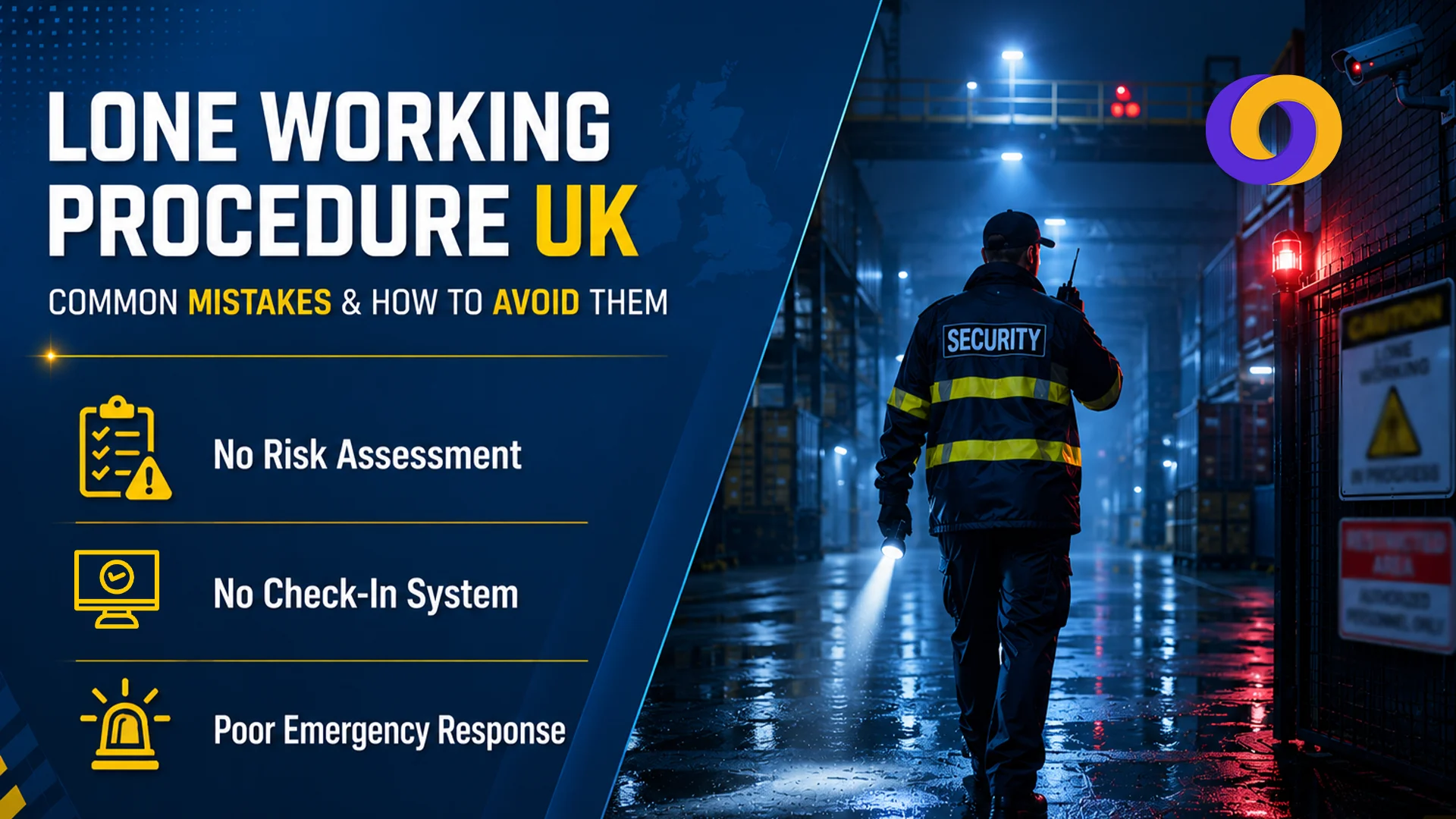
A security guard patrols a warehouse alone at 2am. He slips on a wet floor and hits his head. No one knows. His phone is in his locker. He lies unconscious for three hours before the morning shift discovers him.
This isn’t a hypothetical scenario. It’s a real incident—and it happens more often than most employers realise.
Lone working is more common than many UK employers realise. From field engineers and security staff to cleaners, delivery drivers, and remote workers, thousands of employees work alone every day. According to the Health and Safety Executive (HSE), approximately 8 million people in the UK work alone at some point during their working week.
While lone working is not illegal in the UK, it comes with serious legal responsibilities. Employers must ensure the health, safety, and wellbeing of lone workers under the Health and Safety at Work Act 1974 and the Management of Health and Safety at Work Regulations 1999.
Yet many businesses get it wrong. Poor procedures, weak risk assessments, and a lack of monitoring can lead to serious incidents, legal penalties, and reputational damage.
This guide breaks down the UK legal requirements, the most common lone working mistakes, and how to build a compliant, practical procedure that protects your people.
What is a Lone Working Procedure in the UK?
A lone working procedure is a structured safety process that includes risk assessment, monitoring, emergency response, and regular review to protect employees working alone.
What Is a Lone Worker?
A lone worker is anyone who works by themselves without close or direct supervision, where help would not be readily available if something went wrong.
The HSE defines lone workers as those who work in isolation from colleagues, including those who work:
- In fixed establishments where only one person works (e.g., small shops, petrol stations)
- In separate locations from the rest of the workforce (e.g., different floors or buildings)
- Outside normal working hours (e.g., late-night security or cleaning)
- Away from a fixed base (e.g., delivery drivers, field engineers, care workers)
- From home (remote workers without direct supervision)
Common Examples of Lone Workers in the UK
| Occupation | Typical Lone Working Scenario |
| Security guards | Night patrols at warehouses, offices, or construction sites |
| Delivery drivers | Driving routes alone; unloading at remote locations |
| Care workers | Visiting clients in their homes without colleagues present |
| Cleaners | Working after hours in empty offices or buildings |
| Field engineers | Repairing equipment at remote industrial sites |
| Remote workers | Working from home without physical supervision |
| Retail staff | Opening or closing shops alone |
UK Legal Requirements for Lone Working
Understanding the legal framework is critical before designing your lone working policy and procedure. Employers must comply with several key pieces of legislation:
1. Health and Safety at Work etc. Act 1974
This is the foundational health and safety law in the UK. It requires employers to ensure, so far as is reasonably practicable, the health, safety, and welfare of all employees.
This duty applies equally to lone workers as it does to those working in teams. There is no exemption for lone working.
2. Management of Health and Safety at Work Regulations 1999
These regulations mandate that employers carry out suitable and sufficient risk assessments for all work activities. This includes assessing risks specific to lone working.
The regulations also require employers to:
- Identify hazards specific to lone workers
- Implement appropriate control measures
- Provide information, instruction, and training
- Monitor and review safety measures regularly
3. HSE Guidance on Lone Working
The HSE provides clear expectations for managing lone workers, including:
- Identifying hazards specific to lone working roles
- Assessing risks (considering the task, location, individual, and environment)
- Implementing control measures (monitoring, communication, emergency response)
- Reviewing arrangements regularly
Key principle: Lone workers should not be at more risk than other employees.
Common Lone Working Mistakes (And How to Avoid Them)
Many employers believe they have adequate lone working procedures in place—until something goes wrong. Below are the most common mistakes and how to fix them.
Mistake 1: No Specific Lone Worker Risk Assessment
Many businesses rely on generic risk assessments that don’t address lone working risks. A standard office risk assessment won’t cover the dangers a delivery driver faces alone on rural roads or a care worker visiting a potentially aggressive client.
Why this is a problem:
- Lone workers face unique risks (violence, medical emergencies, isolation, environmental hazards)
- Generic assessments fail to identify these hazards
- This is a direct breach of the management regulations
How to fix it:
Conduct a dedicated lone working risk assessment for each role. Your lone working risk assessment must consider:
| Risk Factor | Questions to Ask |
| Location | Is the area remote, high-crime, poorly lit, or difficult to access? |
| Time of work | Are shifts during night hours, weekends, or public holidays? |
| Task hazards | Does the job involve machinery, hazardous substances, cash handling, or lone travel? |
| Medical fitness | Does the worker have any health condition that could become an emergency when alone? |
| Emergency scenarios | What happens if they fall, are attacked, have a medical emergency, or face equipment failure? |
Document everything. The risk assessment must be written down and accessible.
Mistake 2: No Monitoring or Check-In System
Simply sending someone to work alone without any form of oversight is a major compliance failure and a serious safety risk.
Why this is a problem:
- Delayed emergency response (hours instead of minutes)
- No proof that safety checks are being completed
- Increased legal liability when something goes wrong
- Inability to identify patterns of risk or recurring hazards
Solution:
Implement a reliable lone working procedure for monitoring. Options include:
| Monitoring Method | How It Works | Best For |
| Scheduled check-ins | Worker contacts a supervisor at agreed times (e.g., hourly). Missed check-in triggers escalation | Low-risk roles with phone access |
| GPS tracking apps | Real-time location visible to supervisor; alerts for deviations or stops | Mobile workers, delivery drivers |
| Lone worker safety devices | Dedicated device with panic button, fall detection, and GPS | High-risk or remote lone workers |
| Automated check-in systems | App or phone system prompts worker to confirm safety at intervals | Any lone worker |
| QR code scanning | Worker scans codes at checkpoints; proves presence at specific times | Security guards, patrols |
Crucially: Whatever system you choose, it must have clear escalation procedures for missed check-ins. A missed check-in without follow-up is worthless.
Mistake 3: Inadequate Emergency Procedures
Many employers assume that “call 999” is a sufficient emergency response plan. It is not.
Why this fails:
- The worker may be unconscious, injured, or unable to reach their phone
- The worker may not know their exact location (especially in rural areas)
- The worker may be in a threatening situation where making a call is dangerous
- Delays in identifying the incident can be life-threatening
Best practice:
Define clear escalation procedures for every likely emergency scenario. Your working alone at work procedure should include:
- Panic alerts – One-touch alarm that notifies a monitoring centre or supervisor
- Automatic alarms – Fall detection triggers alert without worker action
- Emergency contacts – Who to call, in what order, and with what information
- Response time targets – e.g., “The supervisor will attempt contact within 2 minutes of missed check-in”
- Location protocols – How to share precise GPS coordinates with emergency services
- Backup coverage – Who responds if the primary contact is unavailable
Example escalation protocol:
- Check-in missed by 5 minutes → automated reminder sent
- Still no response after 10 minutes → supervisor attempts phone call
- No answer after 15 minutes → nearby available worker dispatched
- No success within 20 minutes → emergency services contacted with last known location
Mistake 4: No Training for Lone Workers
Employees are often sent out to work alone without any guidance on safety procedures, risk awareness, or emergency response.
Why this is a problem:
- Workers make poor decisions under stress
- They don’t know how to use safety equipment or monitoring systems
- They may not recognise situations that are genuinely unsafe
- They may not know their rights (including the right to refuse unsafe work)
Solution:
Provide mandatory training for all lone workers before they start working alone. Training must cover:
| Training Topic | What to Include |
| Risk awareness | Specific hazards of their role, location, and working hours |
| Conflict management | De-escalation techniques, when to withdraw, how to report threats |
| Emergency response | What to do in medical emergencies, violent incidents, equipment failure |
| Use of safety tools | How to use GPS apps, panic alarms, check-in systems, and communication devices |
| Rights and responsibilities | Their right to refuse unsafe work; obligation to follow procedures |
| Incident reporting | How and when to report incidents, near-misses, and hazards |
Document all training. Keep records of who was trained, when, and on what topics. Refresh training annually or after any incident.
Mistake 5: Ignoring Mental Health Risks
Lone working isn’t just about physical risk—it’s psychological too. Isolation, lack of social support, and the stress of making decisions alone can take a serious toll.
Why this is a problem:
- Increased risk of stress, anxiety, and depression
- Higher absenteeism and turnover
- Reduced decision-making capability, which increases physical risk
- Potential claims under the Equality Act 2010 if mental health conditions are not supported
Solution:
Incorporate mental health considerations into your lone working policy:
- Regular wellbeing check-ins – Include questions about stress, workload, and isolation in routine calls
- Encourage communication – Ensure lone workers have regular contact with managers and peers
- Provide support channels – Employee Assistance Programmes (EAPs), mental health first aiders, or counselling services
- Monitor indicators – Look for patterns of late check-ins, changed behaviour, or increased absence
- Train managers – Supervisors should know how to spot signs of mental distress and respond appropriately
Mistake 6: No Alternative or Backup Plan
What happens when something goes wrong—a worker is late checking in, a phone battery dies, or a vehicle breaks down? Many employers don’t have a clear answer.
Why this is a problem:
- Delays in emergency response become life-threatening
- Workers may panic or make poor decisions
- Legal liability increases substantially
Solution:
Always have a backup plan. Your lone working procedure example should include clear answers to:
- Who is the secondary contact if the primary supervisor is unavailable?
- What happens if a worker fails to check in?
- What if the monitoring device fails (battery dies, no signal)?
- What if emergency services cannot locate the worker?
- What if the workplace is inaccessible due to weather or incident?
Practical backup measures:
- Designate a backup supervisor for every shift
- Provide spare batteries or portable chargers
- Ensure workers can manually check in via phone if the app fails
- Store worker location data and emergency contacts in an accessible system
Mistake 7: Failure to Review Procedures
Risk assessments and procedures are often created once, filed away, and never revisited.
Why this is a problem:
- Work changes over time—new locations, new hazards, new workers
- Incidents and near-misses become more likely
- Legal liability increases when outdated procedures fail
Best practice:
Review your lone working policy regularly and after specific triggers:
| Review Trigger | Action Required |
| Annually | Schedule a full review of all policies, procedures, and risk assessments |
| After any incident | Investigate what happened, why controls failed, and update procedures |
| After a near-miss | Use the close call as a learning opportunity to prevent future harm |
| When roles change | New tasks, locations, or equipment require updated assessments |
| When new workers start | Induct them into existing procedures; ensure they understand their role |
| When legislation changes | Monitor HSE and ICO guidance for updates |
Document every review. Record what was reviewed, what changes were made, who approved them, and when the next review is scheduled.
Lone Working Procedure Checklist (UK Compliance)
To stay compliant and protect your lone workers, your lone working policy and procedure should include:
| ✔ | Required Element | What It Should Include |
| ☐ | Clear definition of lone workers | Who they are, what roles, when they work alone |
| ☐ | Role-specific risk assessments | Documented assessments for each lone working role |
| ☐ | Monitoring and communication systems | Scheduled check-ins, GPS tracking, or safety devices |
| ☐ | Emergency response plan | Escalation protocols, contact numbers, response time targets |
| ☐ | Training programme | Initial and refresher training; documented records |
| ☐ | Mental health support | Wellbeing check-ins, support channels, manager training |
| ☐ | Incident reporting process | How to report, what to report, investigation procedures |
| ☐ | Backup and contingency plans | Secondary contacts, device failure protocols |
| ☐ | Regular review schedule | Annual reviews and incident-triggered reviews |
Lone Working Procedure Example: A Step-by-Step Template
Here is a lone working procedure example you can adapt for your organisation:
Step 1: Identify lone workers. List all roles where employees work alone, including occasional lone working.
Step 2: Conduct risk assessments. For each role, assess location, time, task, and individual risks. Document findings.
Step 3: Select monitoring methods. Choose appropriate systems based on risk level (e.g., scheduled check-ins for low risk; GPS panic alarms for high risk).
Step 4: Train lone workers. Provide training on risk awareness, emergency procedures, and safety tools before they start working alone.
Step 5: Establish emergency escalation. Define who is contacted, in what order, and within what timeframes when a check-in is missed or an alert triggered.
Step 6: Implement and monitor. Launch the system. Track compliance with check-ins and monitor for issues.
Step 7: Review and improve. Conduct annual reviews and incident-triggered reviews. Update procedures as needed.
Best Tools for Lone Worker Safety
Modern technology can significantly reduce lone working risks and improve compliance. Options include:
| Tool Type | Examples | Key Benefits |
| Mobile safety apps | StaySafe, SafetyLine, SmartWorkforce | GPS tracking, check-in reminders, panic alerts |
| QR code check-in systems | Smart Workforce, GuardPatrol | Proof of presence at checkpoints; audit trails |
| Panic alarm devices | Dedicated lone worker devices | One-touch alert; fall detection; no phone required |
| GPS tracking systems | Real-time location dashboards | Immediate visibility; faster emergency response |
| Automated check-in systems | Voice or app prompts | No missed check-ins; automatic escalation |
These tools provide real-time visibility and enable faster emergency response—both critical for effective lone worker protection.
What Is the Procedure for Lone Working?
The procedure for lone working can be summarised in five steps:
- Assess – Conduct a role-specific lone-working risk assessment
- Plan – Establish monitoring, communication, and emergency protocols
- Train – Ensure lone workers understand risks, equipment, and procedures
- Monitor – Implement check-ins, GPS tracking, or safety devices
- Review – Regularly update risk assessments and procedures after incidents
This cycle ensures continuous improvement and ongoing compliance with HSE requirements.
How Smart Workforce Helps You Stay Compliant
Implementing a robust lone working policy requires the right tools. Smart Workforce provides a comprehensive lone worker management platform designed for UK compliance, including:
- ✔ Real-time GPS tracking – Know where lone workers are at all times
- ✔ Automated check-ins and alerts – Scheduled prompts; automatic escalation for missed check-ins
- ✔ QR-based attendance and safety logs – Proof of presence at checkpoints
- ✔ Panic alerts and fall detection – Immediate notification when a worker needs help
- ✔ Incident reporting and audit trails – Document what happened; demonstrate compliance
- ✔ Compliance-ready reporting – Exportable reports for HSE inspections
Smart Workforce is trusted by UK security companies, facilities management firms, and service sector employers to protect their lone workers while maintaining full legal compliance.
Reduce lone worker risk and stay HSE-compliant
Book a Smart Workforce demo and implement a fully compliant lone working system in days—not months.
Conclusion
Lone working is legal in the UK—but only if managed properly. The biggest risks come not from lone working itself, but from poor planning, weak procedures, and lack of monitoring.
Avoiding the seven common mistakes outlined in this guide—skipping risk assessments, failing to monitor workers, ignoring mental health—can make the difference between compliance and serious liability.
Under UK law, you have a legal duty to protect your lone workers. A strong lone working policy is not just a box to tick for compliance. It is a critical part of protecting your people and your business.
The bottom line: If you have lone workers and you cannot answer “yes” to all the checklist questions above, you are not compliant. Start fixing it today.
FAQs
Is lone working legal in the UK?
Yes, but employers must ensure worker safety through risk assessments, monitoring, and proper procedures. The Health and Safety at Work Act applies equally to lone workers.
Do I need a lone worker risk assessment?
Yes. UK law requires employers to assess risks specific to lone working situations. Generic assessments are not sufficient.
What is the biggest risk in lone working?
Delayed emergency response is one of the most serious risks, especially in isolated environments or when workers are unconscious or unable to call for help.
How do you monitor lone workers?
Using lone worker check-in systems, GPS tracking apps, lone worker safety devices, or automated alert systems. The method must match the risk level of the role.
Is training required for lone workers?
Yes. Workers must be trained in safety procedures, risk awareness, emergency response, and the use of any safety equipment.
Can lone workers refuse to work alone?
Yes, if they believe the work is unsafe and risks are not properly managed. Employers cannot penalise workers for exercising this right.
What tools improve lone worker safety?
Mobile apps, panic alarms, GPS tracking systems, QR code check-in, and automated monitoring tools all improve safety and demonstrate compliance.

0 Comments